The Hawks aren’t moving like a team that wants to sit around and wait. Keeping CJ McCollum on a one-year, $21.0 million extension already said a lot about where their heads are at. McCollum is 35, so that deal isn’t about building for the future. It’s about staying competitive right now.
He averaged 18.7 points after joining the Hawks, gave them real playoff shot-making, and helped them finish 46-36 as the No. 6 seed in the East. That’s a team that thinks it can take a real step forward, not one that’s comfortable being good enough.
They also still own the No. 8 pick, and that’s where this gets interesting. The pick came from the Derik Queen trade, where the Pelicans moved the No. 23 pick and a 2026 first-rounder to get Queen at No. 13 in 2025. One year later, that 2026 first landed at No. 8. That’s a rough outcome for New Orleans, anyway you look at it.
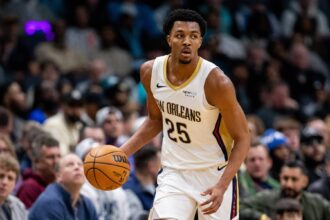
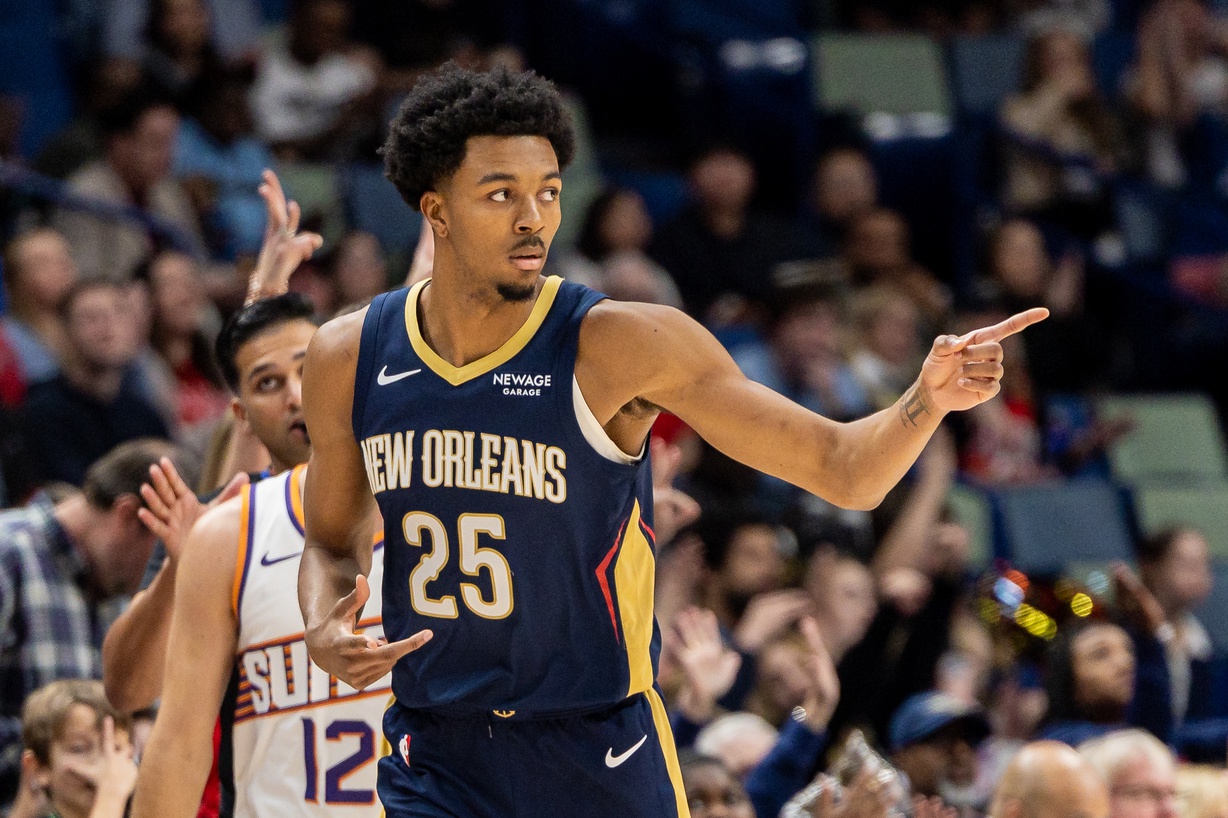
Now Jake Madison, also known as NOLA Jake, reported that the Hawks and Pelicans have had trade talks involving Trey Murphy III and the No. 8 pick. That’s not a small rumor to brush aside. Murphy isn’t some generic wing. He averaged 21.5 points, 5.7 rebounds, and 3.8 assists while shooting 47.0% from the field and 37.9% from three on 8.6 attempts per game.
He’s 25 years old and just starting a four-year, $112.0 million extension at $27.0 million next season. That contract isn’t cheap, but it isn’t alarming either for a 6-foot-8 wing who can shoot, score in movement situations, and punish defenses at the level he does.
If the Hawks actually want him, the package has to reflect that. No. 8 alone doesn’t come close.
The Trade Framework
Hawks Receive: Trey Murphy III
Pelicans Receive: Corey Kispert, Buddy Hield, Asa Newell, No. 8 pick, 2029 first-round pick, 2030 first-round (pick swap), 2031 first-round pick
This is the kind of package that actually makes the Pelicans pick up the phone and stay on the line.
Murphy is making $27.0 million in 2026-27. Corey Kispert is at $13.9 million, Buddy Hield is at $9.6 million, and Newell is at $3.3 million, which gets to roughly $27.0 million going out from the Hawks. The money works. The timing around Hield’s guarantee date needs attention before anything becomes official, but as a framework, the structure is right. The Hawks send enough salary, the Pelicans get useful players, and the pick value is heavy enough to make the conversation real.
The No. 8 pick carries extra weight here because of its history. The Pelicans would essentially be getting their own mistake handed back to them, which is uncomfortable but still doesn’t cover the cost of Murphy alone.
That’s why the 2029 first, the 2030 swap, and the 2031 first all need to be attached. Kispert isn’t filler either. He’s a 6-foot-6 shooter on a reasonable contract who can actually help a team right away. Hield is older but still spaces the floor and could be moved again. Newell is a young frontcourt piece who was already involved in the original Queen deal.
This return isn’t perfect for the Pelicans. But it’s a real one.
Why The Hawks Do It
The honest version of this argument is pretty simple. Murphy is already what teams hope a top-10 pick eventually becomes, and the Hawks are past the point of hoping.
He’s 25, he’s 6’8″, and he just averaged 21.5 points on genuine efficiency with 37.9% from three on over eight attempts per game. That’s elite volume shooting for a wing, and it doesn’t even account for everything else he offers off movement and in transition.
The Hawks already had a top-six offense by points per game at 118.5 and led the entire league with 30.1 assists per game. They move the ball, they play with pace, and they have structure. Murphy doesn’t disrupt any of that. He makes all of it easier because defenses now have to genuinely respect another threat on the floor.
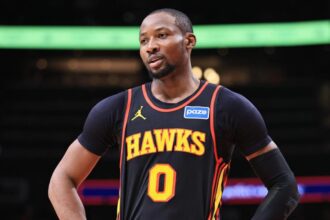
Jalen Johnson is the main young piece. Dyson Daniels gives elite perimeter defense. McCollum gives them a veteran scorer. Onyeka Okongwu gives rim presence and versatility. Nickeil Alexander-Walker and Aaron Wiggins give wing depth. But none of them is Murphy. None of them is a 6-foot-8 wing who can score 21 points with real efficiency and shoot 38% from three in playoff situations. That combination is what actually changes the ceiling of this team.
Kispert can shoot. Hield used to shoot. Newell has some upside down the road. The picks matter in the abstract. But the Hawks just made the playoffs, paid a 35-year-old guard to come back, and have a roster that’s ready to compete right now. That’s not a team that should be drafting and hoping the pick turns into a Murphy-level player in three or four years. They should just go get the Murphy-level player who already exists and is 25 years old.
The contract makes sense, too. Murphy’s extension runs $27.0 million, $29.0 million, $31.0 million, and $33.0 million over the next four years. If he stays close to 20 points per game with elite three-point volume, that’s not an overpay. That’s just what good wings cost in 2026. The Hawks would still keep Johnson, Daniels, Okongwu, McCollum, Risacher, Alexander-Walker, and Wiggins. They’re trading picks and depth, not the core of the team.
This is expensive. It’s supposed to be. A 46-win team that wants to stop being a nice story and start being a real threat makes exactly this kind of move.
Who The Pelicans Should Draft
If the Pelicans trade Murphy and get No. 8 back in the process, they can’t waste it on a low-upside pick just because it feels safe. They traded a 21.5-point wing. They need to replace size, length, and forward talent. They need someone who can eventually give them something close to what Murphy gave them, even if that player isn’t ready for two or three years.
The pick should be Nate Ament if he’s still on the board. He averaged 16.7 points, 6.3 rebounds, and 2.3 assists at Tennessee, although the efficiency numbers are genuinely concerning. He shot 39.9% from the field and 33.3% from three with a 53.4% true shooting mark. That’s the real risk with this pick, and it shouldn’t be glossed over.
But the tools are why this still makes sense for New Orleans. Ament is listed somewhere between 6-foot-10 and 6-foot-11, and he has actual wing skill at that size. NBA.com had him as the No. 4 recruit in the 2025 class, and he averaged 19.3 points, 7.8 rebounds, 4.0 blocks, and 3.7 assists as a high school junior. That’s a rare combination of size, skill, and defensive potential that doesn’t come around often, and the Pelicans went 26-56 this past season. They don’t need a safe pick that turns them into a 33-win team. They need real talent, and they need to swing for it.
The clean version of the rebuild looks something like this: Kispert handles some of the shooting in the short term, Hield gives them spacing they can use immediately, Newell gives them another young frontcourt piece to develop, and Ament becomes the long-term wing bet that the whole thing is built around. That’s obviously not equal to Murphy right now, and it isn’t supposed to be. The Pelicans would be resetting their asset base and betting on upside, which is exactly the right approach for a team at their stage.
If Ament is already gone when they pick, Karim Lopez is the next call. He’s got more feel and is probably the better-fitting prospect. Cameron Carr is an option too, but he feels more like a mid-first target than the right answer at No. 8 after trading away a borderline All-Star wing.
The Pelicans already paid a steep price to get Derik Queen. If they end up with No. 8 back by moving Murphy, wasting it would be almost unforgivable. Ament is risky. But risky with 6-foot-11 wing tools and a real defensive upside is exactly what this situation calls for.