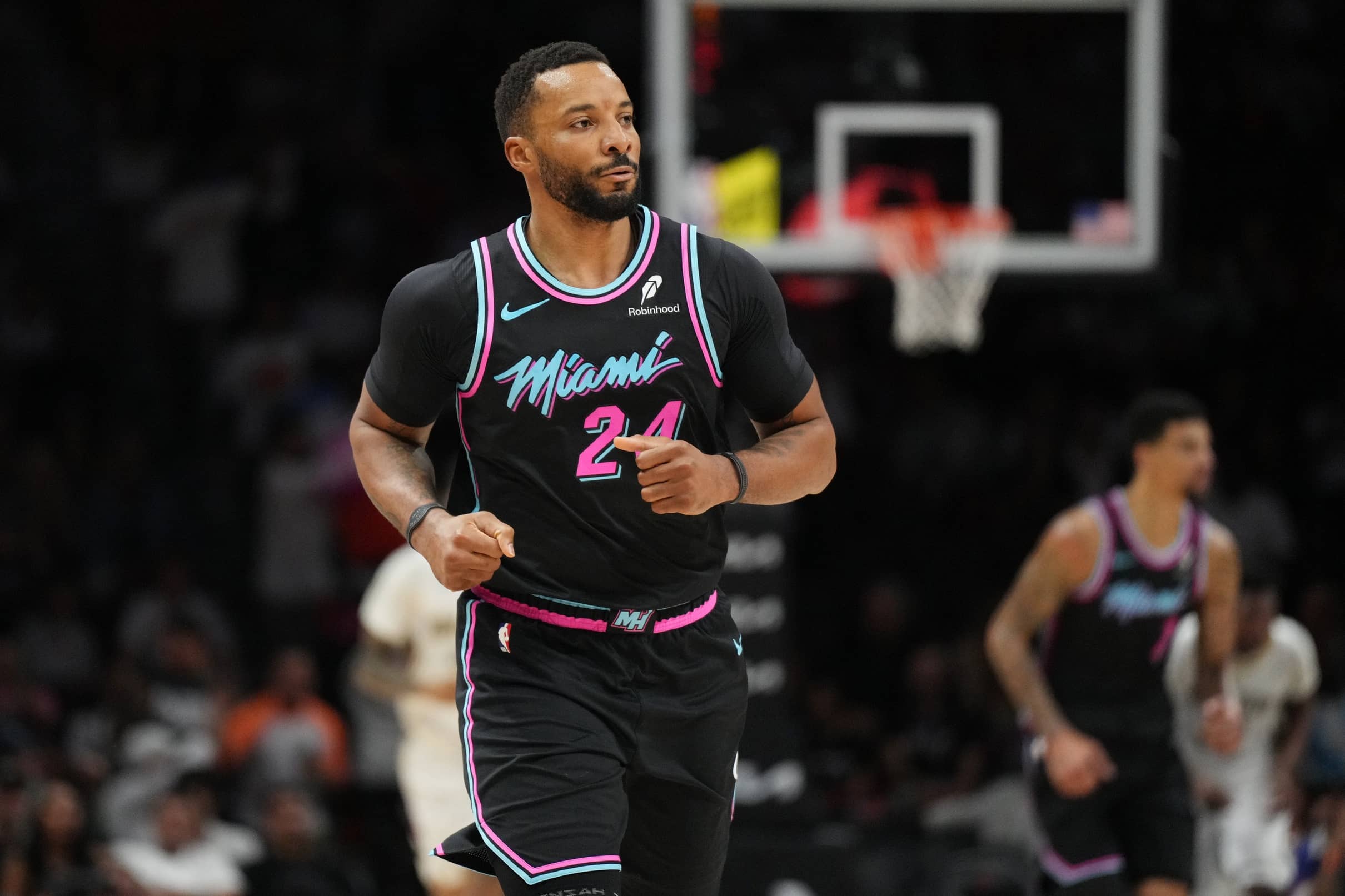
According to the latest intel by Shams Charania, Norman Powell has just agreed to a two-year, $45.0 million deal with the Chicago Bulls, which comes out to $22.5 million a season for a 33-year-old guard.
Not cheap, but not reckless either, given he just averaged 21.7 points, 3.5 rebounds, 2.5 assists, and 1.1 steals on 47.0% shooting (38.0% from three) with the Heat. This wasn’t a name cashing in on reputation. It was one of the better seasons of his career as an All-Star for the first time.
What makes it more interesting is that the Bulls were already moving before this. They pulled off a three-team trade with the Nets and Timberwolves to land Nic Claxton, using cap space to absorb his deal and finally get a real starting center. For a team usually buried under irrelevance, this feels like the start of something good under a new front office and head coach.
The Bulls went 31-51 last year and missed the playoffs again, so nobody’s calling this a contender-making move. It isn’t. But that’s not really the point. This is about a rebuild starting to look like an actual plan rather than a series of disconnected moves. New coach in Tiago Splitter, a real center in Claxton, and now a proven scorer in Powell, that’s a foundation, even if it’s not built to reach a Finals berth.
They needed scoring, they needed shooting, and they needed a veteran who could support the young core without hijacking the offense. Powell checks all three boxes. He can start, close, or anchor bench units as a lead scorer. Not a star, but a legitimate NBA scorer with playoff mileage, exactly what this roster was missing.
Norman Powell’s Grade: A-
This is a strong contract for Powell, genuinely strong. Players his age rarely get paid like this unless they’re still producing at a high level, and $45.0 million over two years hits that balance well. Good money now, without locking him into a long-term situation that could sour.
The role fits pretty well. In Miami, Powell was excellent, but everything shifted after the Giannis Antetokounmpo trade reshaped the roster around Giannis, Bam Adebayo, and Andrew Wiggins’ extension over Powell. His touches (and salary, honestly) were only going to shrink from there. In Chicago, he can remain a primary scoring option on most nights.
That matters for someone coming off a career year. Powell averaged 21.7 points in just 29.6 minutes, elite scoring efficiency by any measure, while shooting 47.0% from the field, 38.0% from three, and posting a 60.9% true shooting mark. Once again, he was an All-Star for the first time ever, and at 33, that’s pretty impressive.
The three-point shooting might be the most important piece. Powell hasn’t shot below 38.0% from three since the 2017-18 season. That’s not a hot streak; that’s a sustained shooting level over years. He’s also a solid fit alongside Josh Giddey, who tends to struggle when the floor is clogged and defenses can sit in the paint. Powell gives him a real target in transition, in the corners, off movement, and can attack closeouts or punish second-side rotations on his own.
Crucially, he doesn’t need an offense built for him. He scores off spot-ups, handoffs, cuts, and late-clock isolations, and he can slot in with the starters or carry a bench group. The Bulls aren’t asking him to run the show, and he doesn’t need to.
The only thing keeping this shy of a full A is age. Powell isn’t 26, and the Bulls aren’t close to contending, so there’s a real chance this becomes more of a trade-deadline asset next year than a long-term piece. Even so, that’s not a bad outcome for him; a guard averaging 20 points on 38.0% three-point shooting will always have a market if Chicago struggles.
Bulls Grade: B+
I like this move for Chicago, not because it transforms the roster, but because it fits the direction they’re actually building in.
This isn’t a team pretending it’s finished. Nobody in that front office thinks Powell alone makes them a top-four East team, that would be absurd. But they’re also not standing still. Claxton first, then Powell, gives them a real starting center and a real perimeter scorer. For a 31-51 team, that’s already a more serious base than they had a month ago.
Claxton matters a lot here. He averaged 11.7 points, 6.9 rebounds, 3.7 assists, and 1.1 blocks across 69 games with the Nets last season. Not a shooter, but a switchable, rim-running, passing defensive anchor. He’s owed $23.3 million in 2026-27 and $21.0 million in 2027-28.
The young pieces benefit, too. Matas Buzelis needs room to operate after a breakout season with 16.3 points, Giddey needs shooters around him, and the wings generally need possessions where the defense is already rotating. Powell provides exactly that kind of relief valve.
The structure of the deal helps as much as the player. $22.5 million annually isn’t nothing, but two years is the sweet spot, long enough to make an impact, short enough to stay flexible. A four-year deal would’ve been risky, three years, questionable. Two years keeps optionality, useful if he plays well, movable if Chicago stays out of contention, and it clears out before it becomes an obstacle to future flexibility.
It also lines up with Claxton’s own two-year timeline, to be fair. That gives the Bulls a defined two-season window to evaluate this group. How Giddey looks with better spacing, how Buzelis develops next to a potential All-Star, and whether Splitter can build a credible defense around Claxton while speeding up the offense around Giddey.
The clear downside is defense. Powell is tough and experienced, but at 33, he’s not someone you want tasked with guarding elite perimeter scorers every night. That burden needs to fall on the younger wings and on Claxton behind him.
There’s also a fair question about whether Powell eats into young players’ reps. I don’t think that’s a real concern here, bad shots born from bad spacing aren’t “development,” they’re just bad habits.
B+ feels right. Not an A, because Powell’s age and Chicago’s remaining talent gap keep this from being a franchise-altering move. But as a short-term, low-risk piece of roster building, it’s a smart, sensible step for everyone involved.
The Heat Lost A Good One
The Heat can absorb losing Powell because they landed Giannis, and that alone reshapes the entire offseason plans. Once a team lands a player like that, everything else gets built around him.
Still, losing Powell isn’t nothing. He led the Heat in scoring last season, helping them go 43-39 and stay in Play-In contention, one of the few players on that roster who could generate quick, clean offense by himself with the lack of a clear No. 1 option.
That’s a hard type of player to replace, especially with Giannis and Bam sharing the frontcourt now. Miami needs shooting to punish defenses that collapse on Giannis drives, and Powell was precisely that release valve.
The Giannis trade was still clearly the right call, nobody skips that deal to keep a 33-year-old guard. But losing Powell does strip away one of Miami’s best spacing pieces, and it puts more pressure on the front office to find shooting elsewhere around the new core.
Which is exactly why this works out well for Chicago. They didn’t sign a washed up name, they signed a player Miami likely would have preferred to keep under different cap restrictions. Older, sure, but still efficient, still productive, still capable in playoff minutes.