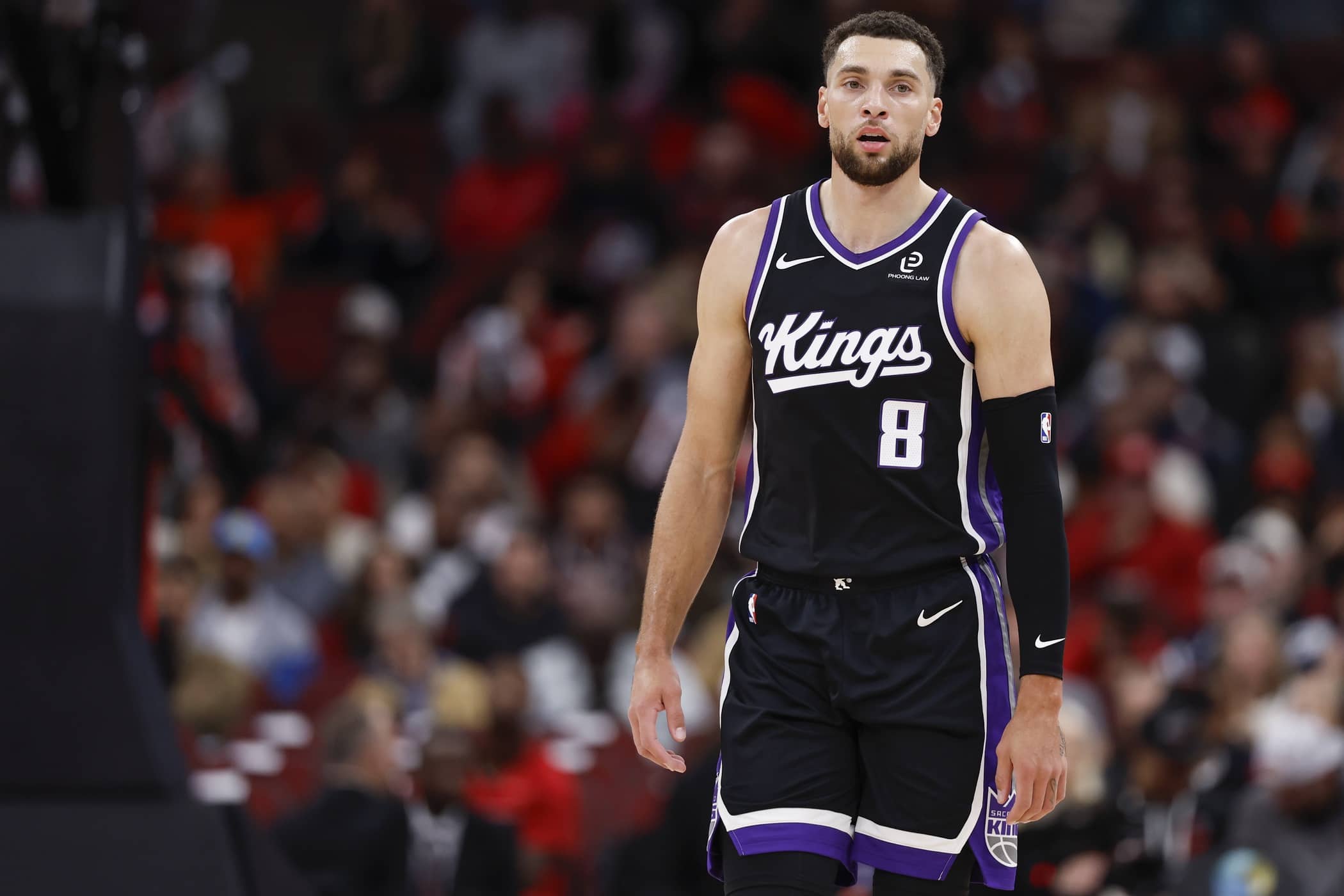
Zach LaVine sits in an odd space in the trade market these days. He’s not cheap, he’s not young anymore, and he’s coming off a season that ended in surgery rather than a strong finish. But that same contract situation is exactly what makes him useful to a handful of teams looking for a short-term fix.
LaVine exercised his $49.0 million player option for 2026-27, setting himself up as a pure one-year scoring rental. That’s really the entire premise here. A team gets a full season of shot creation, spacing and late-clock offense, then watches the money disappear before the 2027 free-agent class opens up.
That’s precisely why Sacramento should be willing to listen. LaVine averaged 19.2 points, 2.8 rebounds, and 2.3 assists across 39 games last season, shooting 47.9% from the field and 39.0% from three, before hand surgery ended his year early.
The scoring ability hasn’t gone anywhere, but that salary no longer matches star-level production like it used to. The Kings finished 22-60, good for 14th in the West, so there’s little reason to pretend this roster sits one move away from contention.
They’re also carrying Domantas Sabonis at $45.5 million, DeMar DeRozan at $25.7 million, Keegan Murray at $24.1 million, and Malik Monk at $20.2 million. That’s a heavy payroll for a team that lost 60 games.
The Kings now should move LaVine, create more financial breathing room by moving the other veteran contracts, land at least one piece that actually fits, and stop paying like a playoff team when the record says otherwise.
These are three packages the Kings would have a real reason to take seriously.
The Clippers Use LaVine As A 2027 Reset Contract
Los Angeles Clippers Receive: Zach LaVine
Sacramento Kings Receive: Brandon Ingram, Gradey Dick
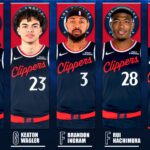
This is the best trade idea because it actually has a real front-office angle for both sides. The Clippers are not doing this because LaVine is better than Brandon Ingram. He is not. They would do it because LaVine is a better contract for their future cap room.
The Clippers just moved Kawhi Leonard to the Raptors for Ingram, Gradey Dick, two first-round picks, one first-round pick swap, and two second-round picks. The move came as part of a transition after earlier trades involving James Harden and Ivica Zubac, and the Clippers now look more like a team trying to get picks, younger pieces, and future relief.
Ingram gives them more talent today. He averaged 21.5 points, 5.6 rebounds, and 3.7 assists last season, shooting 47.7% from the field and 38.2% from three. He is 6-foot-8, he can score from the middle, and he is a better wing creator than LaVine. That is why the Kings would accept this fast.
But the Clippers side is about 2027. Ingram signed a three-year, $120.0 million deal that includes a player option for 2027-28. LaVine is at $49.0 million for one year, and then the money is gone. That gives the Clippers one year of offense, then a better path to chase a star if someone good and young enough gets loose in 2027.
That class is the dream hook. Players like Nikola Jokic, Karl-Anthony Towns, and other major names have free-agent or player-option paths. I wouldn’t say that all of them are really hitting the market because most stars extend or force trades before that. But teams still plan around the possibility.
For the Kings, this is an instant yes because Ingram is a better basketball fit than LaVine. The Kings don’t need another expensive guard next to Monk, Devin Carter, and Darius Acuff. They need size and scoring on the wing. Ingram gives them that right away.
Dick is not a perfect sweetener after a bad year, but he is still 6-foot-7 and still a former lottery pick. He averaged 6.0 points, 1.9 rebounds, and 0.7 assists last season while shooting 41.9% from the field and 30.3% from three. He wasn’t that good, but young shooting prospects are always worth trying when the main win is getting off LaVine’s deal.
This is the one where the Kings would not need to think much. They turn LaVine’s rental money into a bigger forward scorer and a young shooter. The Clippers only do it if they care more about 2027 cap space than Ingram, but that is not crazy after the Kawhi teardown.
The Magic Move Jalen Suggs’ Big Contract Before It Gets Awkward
Orlando Magic Receive: Zach LaVine
Sacramento Kings Receive: Jalen Suggs, Wendell Carter Jr.
This one is not about the Magic giving up on Jalen Suggs as a player. He is still a very good defender, he plays hard, and he can help a winning team. But his contract is big, the Magic already have a more important core, and Anthony Black is right there behind him.
The Magic went 45-37 and finished eighth in the East, so this is not a team starting over. They already made their big move by building around Paolo Banchero, Franz Wagner, and Desmond Bane as the new core pieces. Wagner is at $41.8 million in 2026-27, Banchero is around $41.3 million, and Bane is at $39.4 million. Suggs is next at $32.4 million, with Wendell Carter Jr. at $18.1 million and Black at $10.1 million.
That is why this trade makes sense. The Magic don’t have to move Banchero, Wagner, or Bane. They can keep those guys on the roster, move Suggs before that contract becomes harder to trade, and use LaVine as a one-year offense boost.
Suggs’ playoff series is what makes this conversation a possibility. He averaged 11.1 points, 4.0 rebounds, and 4.1 assists in seven playoff games, but he shot 29.9% from the field and 24.1% from three on 7.7 three-point attempts per game. That is brutal for a guard making $32.4 million, even if his defense is still excellent.
I know he is the Magic’s entire motor and identity, but a team that’s trying its best to really contend can’t have a guard on that contract become that limited in the playoffs, not when Black averaged 15.0 points, 3.8 rebounds, and 3.7 assists last season and makes only $10.1 million.
LaVine helps out with his shooting, more rim pressure, and the ability to score 20 without the Magic needing to run every possession through Banchero or Wagner. The Magic’s offense still gets too heavy when the defense loads up on their forwards. LaVine at least changes that equation with enough outside shooting to help Banchero’s isolation possessions.
The risk is obvious. LaVine is older, expensive, and coming off surgery. But the Magic would not be taking a four-year bet. They would be taking one season, then getting the $49.0 million off the books. That is the part that makes it possible.
The Kings accept because Suggs and Carter could be actually huge for their next retool. Suggs gives them point-of-attack defense and another guard who can play hard next to Acuff or Monk. Carter gives them a useful contract and frontcourt depth. If the Kings move Sabonis later, Carter can soak up center minutes. If they don’t, Carter can still be moved again.
This is not the prettiest trade, but it has logic. The Magic protect Banchero, Wagner, and Bane financially for the future when hard decisions will be due. The Kings get younger and more balanced as LaVine gets one season on a team that badly needs easier scoring.
The Mavericks Use LaVine To Open A Better Future Path
Dallas Mavericks Receive: Zach LaVine
Sacramento Kings Receive: P.J. Washington, Klay Thompson, Caleb Martin
The Mavericks part of this is simple. This free-agent class did not give them many big targets, and the roster still feels like a bridge roster around Cooper Flagg. That is why they should think more about 2027 than forcing one more medium move now.
The Mavericks went 26-56 last season, so they are not a finished product with their young core. They have Flagg, Kyrie Irving, Dereck Lively II, Santi Aldama, and some useful veterans, but they still need to decide what kind of team they are building.
That is where LaVine becomes interesting. The Mavericks don’t need to treat him as a savior. He is not that. They can treat him as one year of scoring next to Flagg and Irving, then let the money expire before they chase younger unrestricted free agents or use cap space in trades.
Washington is the big contract to watch. He averaged 14.2 points, 7.0 rebounds, and 1.8 assists last season, but his three-point shot dropped to 32.5%, and his long-term fit next to Flagg is not a lock with Aldama coming into the squad.
The Mavericks would be sending Washington at $19.8 million, Thompson at $17.5 million, and Caleb Martin at $10.0 million in 2026-27. That is enough salary to make the framework work, and it turns three contracts into one huge expiring-style deal.
This is not about LaVine making the Mavericks a playoff team. It is about one season of offense and then a better money situation. LaVine can still shoot, run in transition, and give them a scorer when Irving sits. For a team that needs more easy points around Flagg, that has value.
The Kings accept because Washington is the best player in the return and fits a real need. The Kings need more forward size, more defensive versatility, and more usable pieces instead of one giant guard salary.
Thompson is short-term shooting and Martin is mainly a salary filler. The Kings would not be getting a star package, but LaVine is not bringing back any type of borderline All-Star in the market anymore.
None of these packages would be called a monster return for LaVine. That is fine. The Kings are not trading 2021 LaVine. They are trading a 31-year-old guard at $49.0 million after a 39-game season and hand surgery. In that market, getting better positional fits, shorter-term options, or more useful money is already a win.