The Mavericks are in a strange rebuilding spot. They finished 26-56, 12th in the Western Conference behind Cooper Flagg, and still have Kyrie Irving and enough veteran salary to improve their future assets.
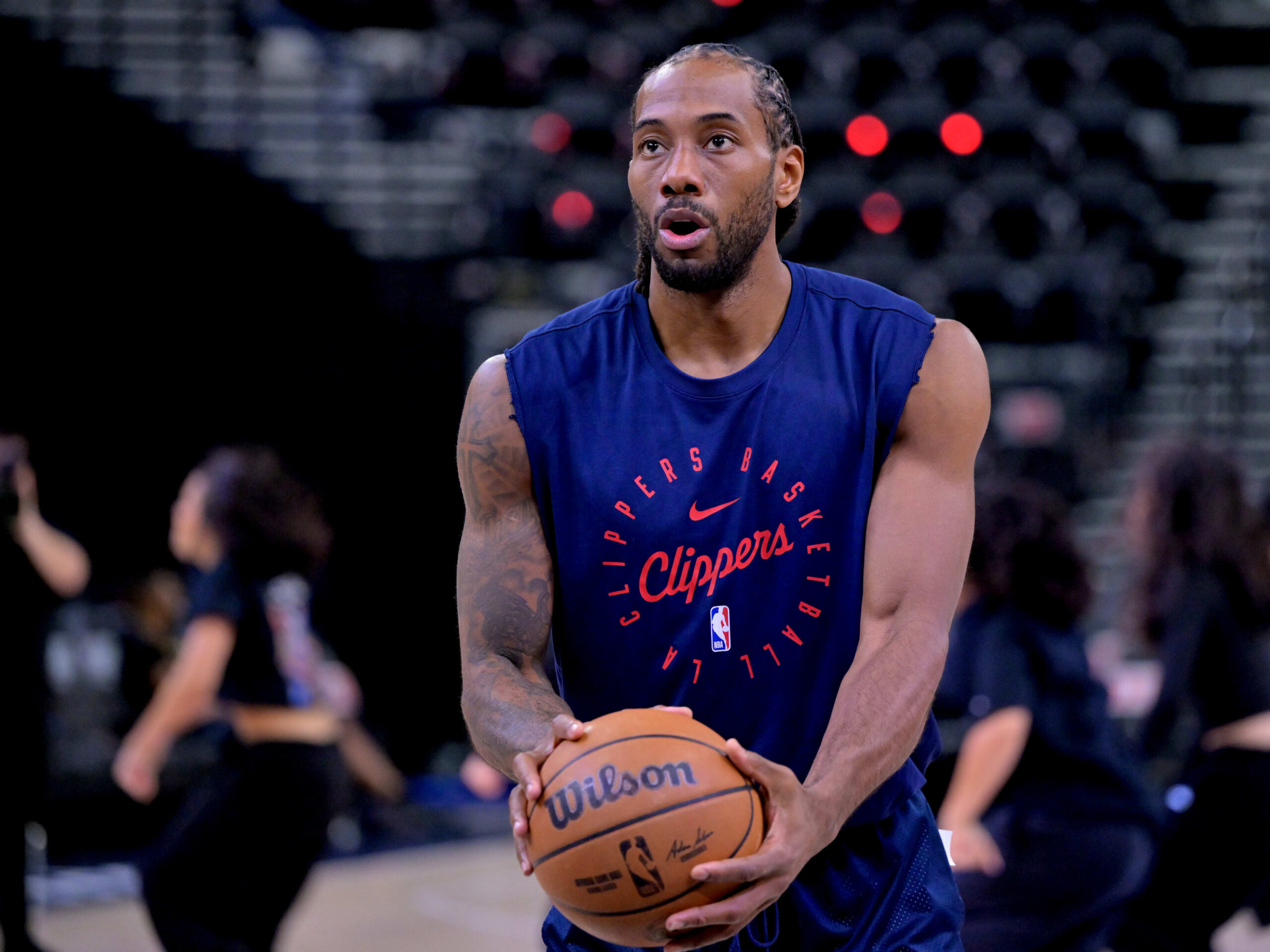
But when Christian Clark, Dan Woike, and Sam Amick of The Athletic reported that the Mavericks and Clippers discussed a trade for Kawhi Leonard, it didn’t make much sense for a non-playoff team.
The reported idea had P.J. Washington, Klay Thompson, and draft compensation going to the Clippers. That is the base. It also tells the full story. The Mavericks want to build around Flagg without waiting five years, which could become tricky if the right pieces are not in place.
Leonard is old, expensive, and never a normal health bet. He turns 35 during the 2026-27 season and is owed $50.3 million on an expiring contract. That alone makes the deal dangerous, combined with the fact that he’d be only open for an extension with the Raptors or Spurs. But his production still isn’t washed. In 2025-26, Leonard put up 27.9 points, 6.4 rebounds, 3.6 assists, and 1.9 steals in 65 games while shooting 50.5% from the field, 38.7% from three, and 89.2% from the line.
The Mavericks need that type of player badly. They were 27th in offensive rating at 111.2, 20th in defensive rating at 116.5, 23rd in net rating at -5.4, and 26th in three-point percentage at 34.4%. Flagg won Rookie of the Year with 21.0 points, 6.7 rebounds, and 4.5 assists, but the team still didn’t have enough reliable creation around him.
Leonard changes that fast. He gives the Mavericks a half-court scorer, a playoff wing defender, and another player who can take pressure off Irving when he returns from his left ACL injury. This is risky, but the Mavericks aren’t tanking completely. They already have expensive veterans, a rookie star, and a front office that may want to push the timeline forward.
Pros
The main pro is simple: Leonard is still a high-level playoff player when his body works. The Mavericks don’t have another player like that on the wing. Flagg may become that, but he is 19 and still learning NBA spacing, physicality, and late-game coverages. Leonard gives the Mavericks a veteran wing who already knows how to score against elite defenses.
The shot creation is the biggest part. The Mavericks had a 111.2 offensive rating, 27th in the league. That number is ugly for a team trying to build around a No. 1 pick and expensive veterans. Leonard would give them a different half-court option. He can post smaller wings, shoot over switches, attack from the elbow, and create without needing 20 dribbles.
His efficiency also fits the problem. The Mavericks were 26th in three-point percentage at 34.4%. Leonard hit 38.7% from three in 2025-26. He doesn’t take only easy corner looks. He can hit pull-ups, late-clock threes, and spot-up shots when Irving or Flagg has the ball. That is important because Flagg needs more spacing, not more traffic.
The Flagg fit is the best basketball argument. Flagg had 21.0 points, 6.7 rebounds, 4.5 assists, 1.2 steals, and 0.9 blocks while shooting 46.8% from the field. His three-point shot was the weak part at 29.5%, but the rest of the rookie season was elite. Leonard helps him because Flagg wouldn’t need to be the No. 1 scorer every night. He could attack closeouts, defend multiple positions, run transition, and grow without being forced to solve every possession.
Kyrie Irving is the other part. Irving missed the 2025-26 season after left ACL reconstruction, so his return is still a major variable. His last healthy season with the Mavericks was 24.7 points, 4.8 rebounds, and 4.6 assists on 47.3% from the field, 40.1% from three, and 91.6% from the line. If he gets close to that level again, the Mavericks would suddenly have three high-end offensive pieces.
A Kyrie-Leonard-Flagg trio gives the Mavericks a much better competitive edge. Irving breaks down guards. Leonard punishes wings. Flagg attacks gaps and mismatches. That structure is much better than asking Flagg to carry too much while Washington, Thompson, and the centers fill in around him.
Leonard also helps the defense. He isn’t the same full-time stopper from the Spurs and Raptors years, but he still has strength, hands, and timing. His 1.9 steals in 2025-26 show the ball pressure is still there. The Mavericks were 20th in defensive rating, and that number needs to rise fast if they want to get back into the playoffs.
The playoff value is the final pro. Leonard has two Finals MVPs. He has done the hardest thing in the NBA, which is scoring against set playoff defenses from the wing. That is the skill every contender needs. The Mavericks don’t need him to play 75 games and chase regular-season awards. They need him for 35 minutes in a second-round series.
That is why the move is worth serious thought. Leonard would make the Mavericks older and more fragile, but he would also give them the highest ceiling they have had since the Luka Doncic trade.
Cons
The first con is the obvious one: Leonard’s body can ruin the whole plan. His talent isn’t the problem. Availability is the problem. The Mavericks already know what that feels like because Irving missed the full 2025-26 season, and the roster never found stability.
Leonard played 65 games last season, which is a strong number by his standards. But that shouldn’t erase the bigger history. The Clippers built around Leonard for years, and the team never reached the Finals. Some of that was roster construction. Some of that was timing. A lot of it was health. If the Mavericks trade rotation pieces and a first-round pick for him, they are accepting the same risk.
Age is another issue. Leonard will be 35 in 2026-27. Irving will be 34. Klay Thompson is already 36, but he would be gone in this framework. The Mavericks would be trying to win with one very young star and two older max-level players. That is a hard balance. Flagg’s timeline is long. Leonard’s timeline is short. Irving’s timeline is also short because of the knee injury.
The contract is heavy, even if it ends soon. Leonard’s $50.3 million salary is huge. It would keep the Mavericks very expensive and limit flexibility around the rest of the roster. The good part is that he becomes a free agent in 2027, so this isn’t a four-year problem. The bad part is that one season at that number still controls a lot of roster decisions.
The trade cost also hurts. P.J. Washington is not a star, but he is a useful forward in the right role. He gave the Mavericks 14.2 points, 7.0 rebounds, and 1.8 assists last season, and his size lets him guard both forward spots. Losing him removes a player who fits next to Flagg because he can defend, rebound, and play without needing many touches.
Klay Thompson isn’t prime Klay anymore, but he still hit 38.3% from three. His 11.7 points, 2.1 rebounds, and 1.4 assists in 69 games don’t look huge, but the shooting gravity still has value. The Mavericks were already 26th in three-point percentage. If Thompson leaves, Leonard helps, but the team still needs more shooting around Irving and Flagg.
Daniel Gafford would be the painful extra salary in this version. He gave the Mavericks 9.5 points, 6.9 rebounds, and 1.3 blocks while shooting 65.5% from the field. That is useful center production. If Gafford goes out, the Mavericks need Dereck Lively II to be healthy and Morez Johnson Jr. to be ready faster than planned. That is another risk.
Depth becomes the main roster problem. A top group of Irving, Leonard, Flagg, and Lively has a lot of talent. But after that, the Mavericks need shooting, backup ball-handling, and frontcourt size. The 2025-26 team already had problems with spacing and organization. Trading three rotation players for one expensive star creates another roster hole if the minimum signings and young players aren’t ready.
The draft pick cost is also serious. The Mavericks’ own draft capital is complicated because of past trades and swaps. The Lakers’ 2029 first-round pick is a strong chip. Trading it for Leonard means the Mavericks are choosing an older win-now path over more Flagg-era flexibility.
That is the hard part. Leonard makes them much better now. He also raises the chance that the Mavericks end up with a thin, old, expensive team if injuries hit again.
Trade Scenario Explained
Dallas Mavericks Receive: Kawhi Leonard
Los Angeles Clippers Receive: P.J. Washington, Klay Thompson, Daniel Gafford, 2029 first-round pick (via LAL)
This is the framework that makes the most sense given the reported base was Washington, Thompson, and draft compensation. That is a good start, but the Clippers might need another contract included. Leonard makes $50.3 million in 2026-27. Washington is at $19.8 million, Thompson is at $17.5 million, and Gafford is at $17.3 million. Together, the Mavericks would send out about $54.5 million.
That works better because the Mavericks would take back less money than they send out. It also helps them avoid forcing a tighter matching structure. From the Clippers’ side, the money is also easier to understand. They would turn one $50.3 million star contract into three movable contracts and a future first-round pick.
The Clippers finished 42-40 and 9th in the Western Conference. That is the danger zone for an old, expensive roster. If they decide Leonard won’t carry them back into the top tier of the West, this type of trade gives them a way to reset without bottoming out fully.
Washington would give the Clippers a 28-year-old forward on a long deal. That contract starts at $19.8 million in 2026-27 and runs through 2029-30. For a team trying to get younger without losing all structure, he is the main player piece. He can defend bigger wings, rebound, and play next to a high-usage guard.
Thompson is more about money and shooting. His $17.5 million deal expires after 2026-27. That gives the Clippers cap flexibility in 2027. He also gives them a veteran shooter if they still want to stay competitive around Darius Garland and the rest of the younger core. If the Clippers go deeper into a rebuild, they can move him later or let the contract expire.
Gafford is the third piece that gives the Clippers another tradable player. He is on a $17.3 million salary for 2026-27 and has center value because of rim finishing, rebounding, and shot-blocking. The Clippers already traded Ivica Zubac, so Gafford might be a perfect roster fit.
The 2029 Lakers’ first-round pick is the asset that makes the Clippers listen. That pick came from the Luka Doncic trade and has more value than a closer late first. The Lakers could still be good in 2029, but they also have a lot of age and uncertainty around that timeline. A pick that far out gives the Clippers upside.
For the Mavericks, the roster after the deal becomes easier to define. Irving is the lead guard. Leonard is the half-court wing scorer. Flagg is the young star forward who can fill every gap. Lively becomes the main center if healthy. Morez Johnson becomes more important right away because the Mavericks would lose Gafford.
A possible closing group could be Irving, Max Christie, Leonard, Flagg, and Lively. That group has more defensive size than last season and a much better scoring hierarchy. Irving and Leonard create. Flagg attacks as the third option. Christie defends guards and hits spot-up threes. Lively screens, rebounds, and protects the rim.
The Mavericks would still need to add shooting. That part can’t be ignored. Leonard shot 38.7% from three, and Irving is a career 39.4% three-point shooter, but Flagg hit only 29.5% as a rookie. If Thompson and Washington are gone, the Mavericks need at least two low-cost shooters. They also need Ryan Nembhard to become a key bench guard because Irving’s knee makes workload management necessary.
The trade only makes sense if the Mavericks think Leonard can play 55 to 65 games and be ready for the playoffs. If they think he is a 35-game player now, this is too much. Washington, Gafford, Thompson, and the 2029 Lakers’ first-round pick is a serious price.
Still, I would do it if the Clippers don’t ask for Irving, Lively, or multiple first-round picks. Leonard is old, but he is still the kind of wing the Mavericks don’t have. The Mavericks were 26-56 with bad offense, weak shooting, and no top-level wing creator. Leonard fixes the hardest part first.
The final answer is yes, but with a strict limit. The Mavericks should acquire Kawhi Leonard if the cost stays around Washington, Thompson, Gafford, and one strong first-round pick. That version gives the Mavericks a serious ceiling without destroying the full Flagg timeline. It is aggressive, risky, and expensive. But after a 26-win season, the Mavericks need something bigger than normal rotation upgrades.