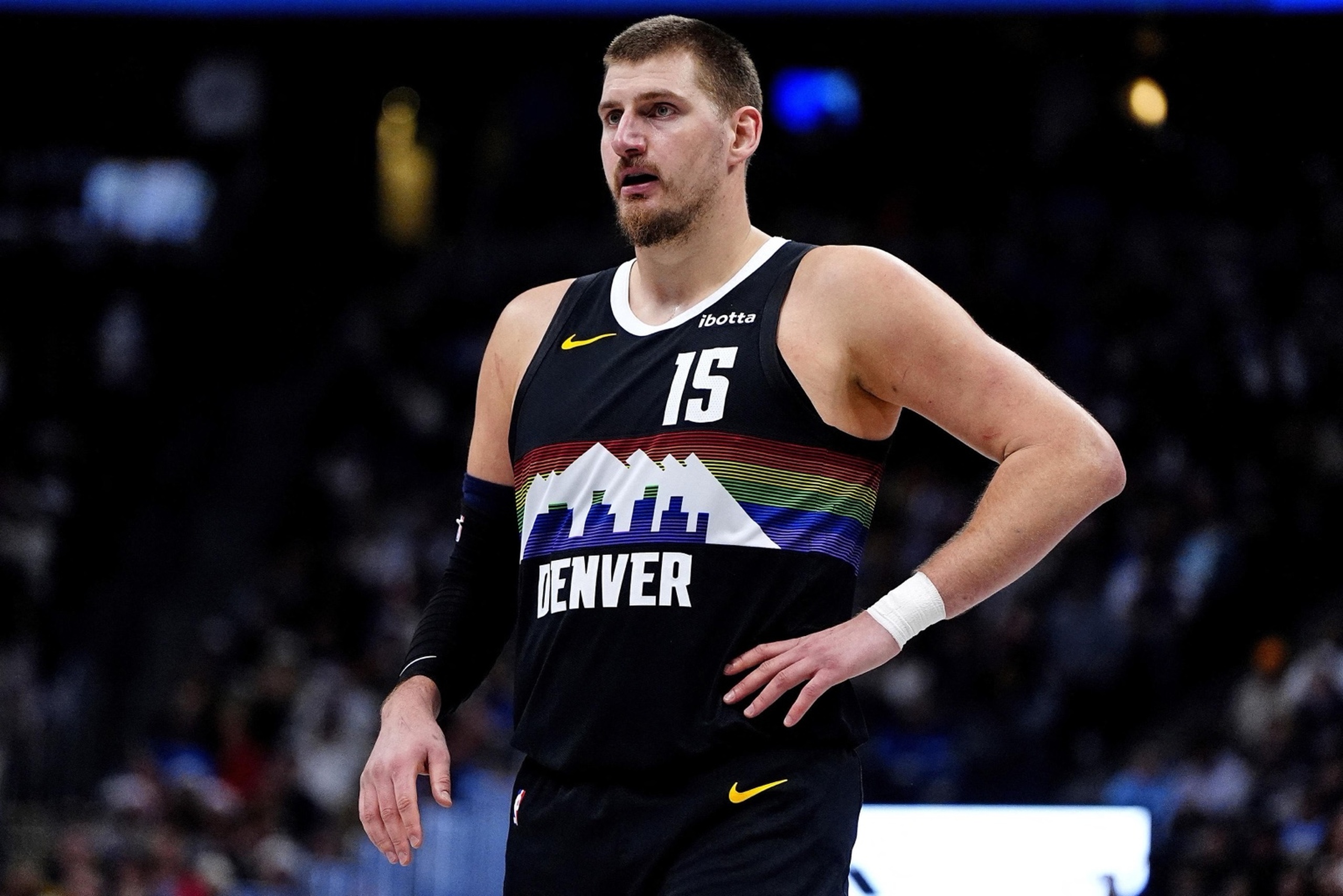
Nikola Jokic is still doing things on a basketball court that don’t really make sense for a seven-footer, but the Nuggets are starting to feel like a team that needs one more real difference-maker before this stretch of his prime slips away.
Jokic posted 27.7 points, 12.9 rebounds, and 10.7 assists across 65 games last season, shooting 56.9% from the field and 38.0% from three, and those numbers barely do justice to what he actually means to that offense.
The issue has never really been Jokic himself, and it rarely is with him. The issue is that Denver still finished 54-28, landed third in the West, and got bounced in the first round by the Timberwolves in six games. The offense was outstanding all year, leading the entire league at 122.1 points per game, but once the playoffs slowed everything down and the physicality ramped up, the roster around Jokic looked thin in exactly the moments that matter most.
None of this means Denver should panic, and doing something reactionary would honestly be a mistake at this point. Jokic, Jamal Murray, Aaron Gordon, Christian Braun and Cameron Johnson still form a legitimate foundation to build from. But there’s a real argument that the front office needs to be aggressive this offseason with a defensive upgrade on the perimeter.
The Thunder are deep at every position, the Spurs are loaded with talent, the Lakers reshaped their whole identity around Luka Doncic, and the Timberwolves just knocked this exact roster out of the playoffs. This isn’t the moment to be conservative with however many prime years Jokic has left.
What Denver needs is one more player who can defend at a high level, create offense on his own, or simply give Jokic a different kind of athletic complement than what’s already on the roster. There are no simple trades or signings to pull off, but simplicity isn’t really the priority for a team in Denver’s position right now.
Jonathan Kuminga Gives Denver A Cheap Athletic Bet
He’s not a superstar and his two-way game has yet to be seen at its fullest, but Jonathan Kuminga might be the most realistic target to land, and that alone makes him worth exploring.
The Hawks declined his $23.4 million team option for 2026-27, which turned him into an unrestricted free agent only months after he was shipped from Golden State to the Hawks as part of the Kristaps Porzingis deal in February.
That situation is exactly why Denver should be making calls. Kuminga averaged 12.2 points, 5.6 rebounds, and 2.3 assists last season on 46.3% shooting, and during his brief stretch with Atlanta, he put up 12.3 points and 5.3 rebounds across 16 regular-season games before bumping that to 13.7 points and 3.3 rebounds in the playoffs against the Knicks. None of those numbers scream star potential yet, but he’s still only 23 years old, and that matters quite a bit for a Denver roster that has gradually aged around its franchise player.
Kuminga brings something the Nuggets simply don’t have enough of on their current roster, which is pure downhill athleticism. Jokic has a way of making cutters look like far better players than they actually are, because he processes the floor and finds openings before most defenses have even reacted to them.
Kuminga isn’t a polished shooter, and he’s not much of a passer, but he can cut hard, run the floor in transition, finish above the rim, and punish a mismatch the moment the ball reaches him in space. Playing alongside Jokic, that ball is going to find him in space far more often than it did in Golden State or Atlanta.
Still, he hasn’t shown he can be trusted with heavy playoff minutes on a consistent basis, his jump shot remains streaky at best, his decision-making in tight windows can be a beat slow, and his role has shifted dramatically from stop to stop over the past year. Given that, a contract in the range of a mid-level exception, somewhere around $15.0 million, is realistically where his market could settle with his injury history and inconsistent usage across two franchises.
For Denver, the complicated part isn’t the basketball fit but the finances behind it. The Nuggets currently sit above the first apron at $209.0 million for 2026-27, with the second apron sitting at $221.6 million. That positioning means Denver almost certainly needs to move salary elsewhere or find a contract number friendly enough to make signing Kuminga realistic under the current cap rules.
Even with those complications, this is a call worth making. If Kuminga’s market ends up softer than people expect around the league, Denver should absolutely be one of the teams trying to sell him on what playing next to Jokic could do for his career.
Derrick White Would Fix A Lot Of Playoff Problems
Denver Nuggets Receive: Derrick White
Boston Celtics Receive: Cameron Johnson, Julian Strawther, 2031 first-round pick
Derrick White might not be the flashiest name on this entire list, but he could genuinely be the single best win-now fit available to Denver this summer. What the Nuggets need is another guard capable of defending at a high level, shooting from distance, making sound decisions, and playing without the ball in his hands.
White checks every one of those boxes, and he’s proven he can do it specifically in playoff basketball, which is exactly why Boston has reportedly been so resistant to moving him.
According to reporting from Jon Krawczynski of The Athletic, the Timberwolves had been aggressive in pursuing White over the past several months, but the Celtics had turned away those advances. Rival contenders view White as the type of guard capable of swinging an entire playoff series in their favor, but Boston isn’t interested in moving on from him, even with them moving Jaylen Brown for salary flexibility.
White averaged 16.5 points, 4.4 rebounds, 5.4 assists, 1.1 steals, and 1.3 blocks across 77 games last season, and that combination of numbers is almost absurd for a guard his size. The blocked shots in particular stand out because, at 6-foot-4, he still manages to protect the rim like a much bigger wing at times, takes charges willingly, rotates early on defensive possessions, and rarely makes careless mistakes.
His production dipped noticeably in the playoffs, and that’s a fair point of concern for this trade. White averaged just 11.1 points, 3.3 rebounds and 3.1 assists across seven playoff games against Philadelphia, shooting only 32.1% from the field and 27.3% from three during that stretch.
Still, it feels premature to overreact to a single rough series when his broader body of work paints a much more encouraging picture, and his defensive impact tends to travel regardless of how his shot is falling on a given night.
The financial commitment is substantial, though not unreasonable given his overall impact. White is locked into a four-year, $118.0 million contract, carrying a $28.1 million cap hit for next season and averaging out to $29.5 million annually. For a starting-caliber guard who defends, shoots, and holds up through deep playoff runs, that price tag is fair rather than excessive.
Convincing Boston to actually make this trade is the harder part of the equation. The Celtics just moved on from Jaylen Brown, they still have Jayson Tatum anchoring the roster, and the front office needs to decide internally whether this offseason represents a retool or a much deeper organizational reset.
Cameron Johnson would give them a 6-foot-8 shooter and useful wing salary, Julian Strawther would add a promising young scorer, and the 2031 first-round pick provides future draft equity. If Boston decides it wants more than that in return, Denver may simply not have enough left to offer without touching Murray or Gordon.
Even so, if the Nuggets can find a way to get this deal done, it’s worth pursuing aggressively. Jokic doesn’t need another teammate who needs 22 shots a night to feel involved. He needs another mature, dependable presence who makes every possession simpler for everyone else on the floor. White fits that description about as well as anyone realistically available this summer.
Trey Murphy III Is The Dream Wing Next To Jokic
Denver Nuggets Receive: Trey Murphy III
New Orleans Pelicans Receive: Cameron Johnson, Christian Braun, 2031 first-round pick
Trey Murphy III represents the best possible fit on this entire list, and if Denver could only pursue one addition to play alongside Jokic, Murray and Gordon, it would probably be him.
At 6-foot-8, he can shoot from well beyond the arc, attack a closing defender, and has developed into far more than the standstill movement shooter he was once viewed as coming out of college.
Murphy put up 21.5 points, 5.7 rebounds, and 3.8 assists last season, shooting an efficient 47.0% from the field, 37.9% from three, and 88.6% from the free-throw line. He connected on 214 made three-pointers across 66 games, which tells you this isn’t some small-sample shooting specialist getting inflated numbers in limited minutes.
The contract situation also works in Denver’s favor here relative to his production. Murphy signed a four-year, $112.0 million extension with New Orleans, with his 2026-27 salary at $27.0 million. That’s a significant number, but for a 26-year-old wing averaging more than 21 points a night while shooting nearly 38.0% from deep, it’s far from an unreasonable price to pay in the current market.
The reporting around Murphy suggests this isn’t just speculation from Denver’s side either. Jake Fischer noted that teams around the league “absolutely want” Murphy, while New Orleans has reportedly shown little interest in a package built primarily around draft compensation, preferring instead a return that helps the roster improve immediately if they do decide to move him.
That’s exactly why Christian Braun has to be included in a realistic offer here, even though Denver would genuinely hate parting with him. Braun is homegrown, defends at a high level, runs the floor relentlessly, and fits seamlessly alongside Jokic in ways that are hard to replace.
But if New Orleans isn’t simply looking to stockpile draft picks, then a package built around Johnson and a single first-rounder likely falls short of getting a deal done. Braun gives the Pelicans a young, championship-tested guard, Johnson adds shooting and size on the wing, and the 2031 first-round pick provides one genuine future asset to build around.
New Orleans finished just 26-56 last season, which means the organization is approaching a genuine crossroads in terms of direction. There’s a reasonable argument for keeping Murphy simply because he’s young, talented, and still improving.
But if the front office decides to reshape its timeline around Zion Williamson, Dejounte Murray, Derik Queen, and Yves Missi instead, a two-player package plus a first-round pick might appeal more than paying everyone at once on an increasingly expensive roster.