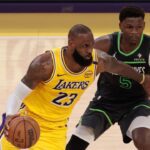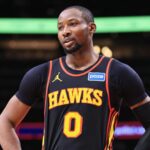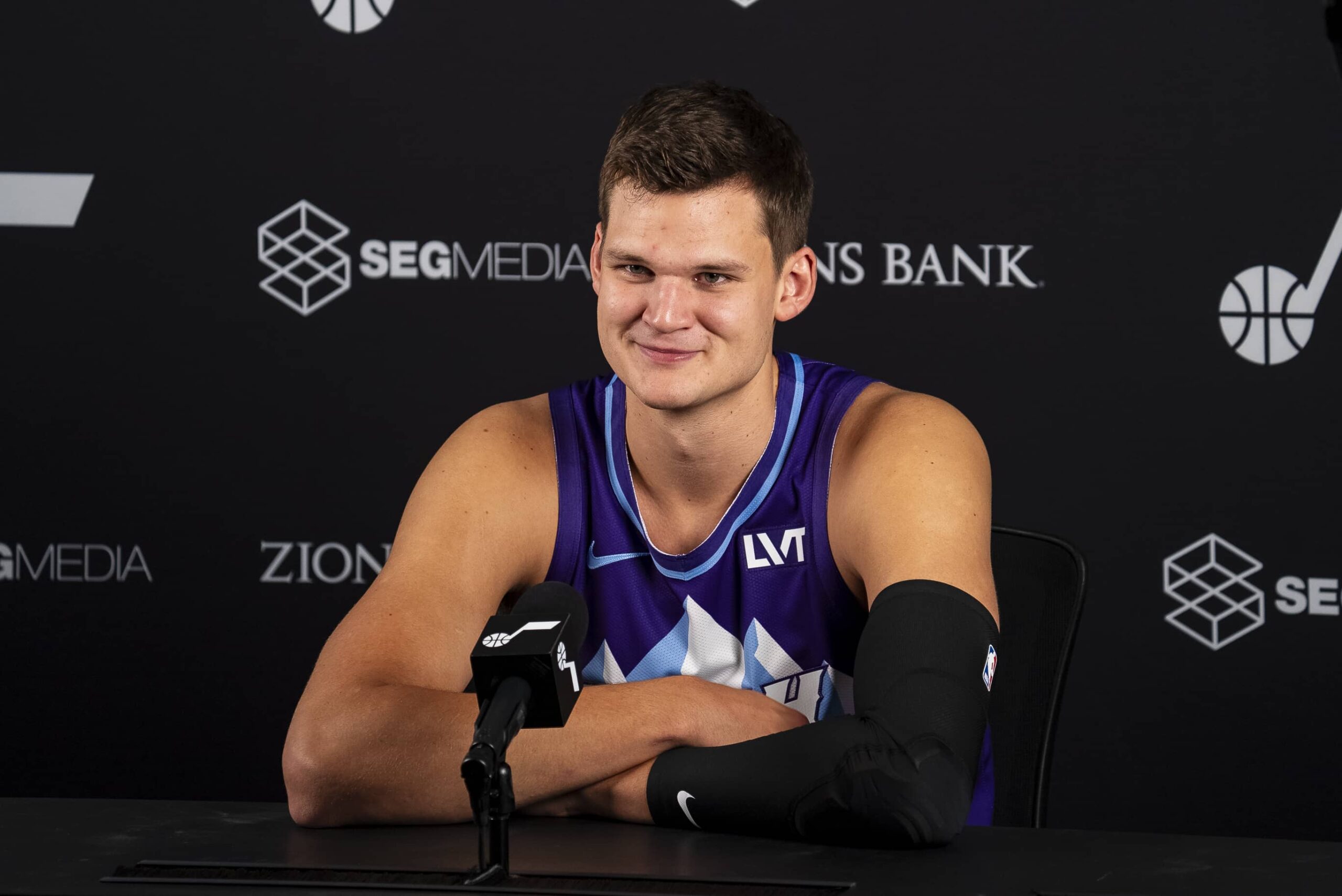
According to Shams Charania of ESPN, the Lakers are acquiring Walker Kessler from the Jazz in exchange for unprotected first-round picks in 2031 and 2033, along with first-round pick swaps in 2028 and 2030. Kessler is also signing a four-year, $130.0 million contract with a player option in year four and a full trade kicker attached.
That’s a heavy price to pay, and not because Kessler isn’t good, because he clearly is one of the better young rim protectors in the league right now. But two unprotected firsts that far into the future is a lot to give up, and stacking two swaps on top of that makes it heavier still, as the Lakers have run out of first-rounders for the next seven years.
But even with this high cost in draft capital, the trade is aimed at keeping Luka Doncic satisfied and confident in the Lakers’ ability to build a competitive roster around him, his skill set, and his defensive needs.
The Lakers have him in his prime coming off a season where he averaged 33.5 points, 7.7 rebounds and 8.3 assists, and they just locked in Austin Reaves on a four-year, $185.0 million deal after he put up 23.3 points, 4.7 rebounds and 5.5 assists. So the backcourt is set. The issue was always what stood behind it.
With LeBron James announcing his departure from the franchise and already confirming the exits of key role players, such as Luke Kennard to the Suns and Marcus Smart landing with the Rockets, the Lakers needed extra help at the defensive end.
Walker Kessler solves that. He averaged 14.4 points, 10.8 rebounds, 3.0 assists, 1.4 steals, and 1.8 blocks while shooting 70.3% from the field last season, though he only played five games before season-ending surgery for a torn labrum in his left shoulder.
Even so, the basketball logic isn’t complicated. Doncic needs a center who screens, dives, catches lobs, protects the rim, and doesn’t need touches to be effective, and that’s exactly Kessler’s profile.
The Lakers already have Deandre Ayton locked in for an extra season in his $8.1 million player option, but Kessler has always been the main target to pair up with their explosive backcourt.
So the real question becomes whether they overpaid for a player who barely played five games last season, was at odds with his franchise, and had already rejected a contract extension.
Lakers Grade: B
The Lakers land on a B because the fit is close to perfect, but the cost attached to it is genuinely risky. Don’t get me wrong: Kessler will be a huge addition, but if the roster is not an instant top seed, there’s not much mid-season capital to move after this one.
Kessler is the type of center that tends to make Doncic look even better than he already is. He sets the screen, rolls hard, catches around the rim, finishes without needing extra dribbles, and forces the low man into an impossible decision.
Tag him, and Doncic finds the corner shooter. Sit back too far, and Luka gets his floater or steps into the pocket midrange look. Switch it, and Kessler just seals the smaller defender. It’s simple stuff on paper, but with Doncic running it, that simplicity becomes easy playoff offense.
That’s what we saw with the Mavericks’ Finals run in 2024, as Dereck Lively II put up 7.9 points and 7.4 rebounds as a rookie in the postseason, while shooting over 68% from the field. With Kessler already coming off a double-double season, his offensive numbers could climb even more.
The defensive upgrade might matter even more. Kessler posted a 5.6 block percentage last season and has averaged 2.4 blocks per game for his career, which is significant for a Lakers team that desperately needed a back-line presence given that Doncic and Reaves are both offense-first players. They compete hard, but neither one is erasing drives at the rim, and Kessler now gives them a legitimate answer there.
That part of the deal is easy to like. The roster finally has a logical shape to it: Doncic runs the show, Reaves is the second scorer and playmaker, and Kessler anchors the defense and gives them a vertical target. Add enough shooting and wing defense around those three pieces, and this becomes a serious team.
But the grade can’t climb higher than a B because those picks are frightening. The 2031 and 2033 first-rounders are fully unprotected, meaning the Jazz get them regardless of what happens, no top-four protection, no safety net if the Lakers collapse. Doncic will be 32 in 2031 and 34 by 2033, and his current deal only runs through 2028.
The Lakers have also added Sandro Mamukelashvili on a four-year, $52 million deal, with Quentin Grimes agreeing to a four-year, $60 million contract and Collin Sexton signing for two years and $19 million, as Shams Charania has just broken down. The picture is becoming pretty obvious at this point: the Lakers are spending future assets and money like a team that genuinely believes its window is right now
Still, the swaps in 2028 and 2030 add another layer of concern, too. It’s easy to dismiss swaps as lesser assets, but they aren’t, since they restrict flexibility and hand Utah upside while also complicating any future trade the Lakers might want to make.
That’s simply the cost of operating with urgency right now. The Lakers are essentially saying the distant future doesn’t matter as much as this current window with Doncic, and honestly, I get that reasoning. You don’t trade for a player of Luka’s caliber, watch LeBron walk out the door, and then start protecting 2033 picks like you’re rebuilding.
Still, that’s an enormous price for a non-All-Star center on a $130.0 million contract. If Kessler stays healthy and turns into a top-three defensive center, none of this will matter to Lakers fans. If the shoulder becomes a recurring issue, or playoff defenses find ways to pull him away from the basket, this could age very poorly.
So the move itself is sound, and the reasoning behind it makes sense, but the price tag is steep by any measure.
Jazz Grade: A-
Utah handled this about as well as they could have. Kessler wasn’t an easy player to manage as a restricted free agent looking for a major payday, and he’d already turned down a five-year, $140.0 million offer from the Jazz, according to ESPN, which tells you exactly how wide that gap really was. Utah could have kept negotiating and matched an offer, committing big money, or they could flip him for premium future assets instead.
They chose the latter, and it’s hard to argue with the logic. With Lauri Markkanen and Jaren Jackson Jr. already making max money for next season, keeping Kessler would have been expensive for a likely bench role. And a frontcourt of the three would be huge, but maybe too tall for the modern NBA.
The return here is… even better than every projection. Two unprotected first-rounders from the Lakers are precisely the kind of haul that can swing wildly between contention and disaster given how quickly stars can arrive or leave in Los Angeles.
Sure, the 2031 and 2033 picks could land somewhere in the twenties if everything breaks right for the Lakers. Doncic stays great, Kessler thrives, Reaves is still around, and the roster stays intact. But there’s also a real chance those same picks turn into something far more valuable, and that uncertainty is really the whole point for Utah. They’re not just banking on today’s value, they’re buying into the volatility of tomorrow.
The swaps sweeten the deal further. Even if Utah never actually exercises them, having that control gives them leverage to use elsewhere down the line, more draft equity, and more patience to work with.
Utah also sidesteps paying Kessler more than his role probably justifies. He’s good, but he’s not a primary core piece or a true scoring option, and committing $130.0 million to that kind of player on a weird roster can get uncomfortable fast.
The only thing keeping this shy of a full A grade is that Kessler is still only 24 and genuinely talented, so there’s real risk in losing a young defensive anchor like this. He was part of the return in the Rudy Gobert trade, and if he blossoms into a Defensive Player of the Year caliber piece for the Lakers, that’s going to sting in Utah for a while, even with Jaren Jackson Jr. already holding that DPOY trophy in the frontcourt.
Even with that risk, this was the right asset decision. The Jazz didn’t get attached, they sold high on a restricted free agent who wanted a big number and came with some injury concerns, paving the way for a future Keyonte George extension next summer.
Walker Kessler Grade: A
This is about as good as it gets for Walker Kessler personally. Four years, $130.0 million works out to $32.5 million annually for a center who’s never made an All-Star team and played just five games last season. That alone is a massive individual win.
The structure of the deal helps him even more. That fourth-year player option gives him leverage, letting him opt out and chase another payday if things go well, or simply keep the guaranteed money if they don’t. The full trade kicker adds another layer of protection in case the Lakers ever decide to move him.
Financially, it’s an easy A. On the court, it’s arguably just as strong. Kessler goes from a potential bench situation in Utah to playing playoff minutes alongside Doncic, and that’s about as ideal as it gets for his particular skill set.
That’s the best possible version of his role, realistically.
Playing next to Doncic should make his life even easier offensively. Kessler shot 70.3% last season largely because most of his attempts come right at the basket, and now he’ll have one of the best passers in the league setting him up.
Expect Doncic to find him on lobs, short rolls, seals, and simple dump-offs, and it wouldn’t be surprising if Kessler ends up averaging something like 12 to 15 points a night without a single play ever being for him.
The pressure is really the only catch in this situation. Kessler isn’t walking into this as some low-cost role player. He’s arriving attached to two unprotected first-rounders, two swaps, and a $130.0 million contract, and that changes how people will view him from day one. Lakers fans aren’t going to treat him gently, they’ll expect the defense to be fixed immediately.
And even with his shoulder uncertainty hanging over him, this is exactly the outcome most players dream about: the money, the role, a superstar teammate, a massive market, and a real shot at meaningful games after the season. By any measure, Kessler comes out of this a winner.
Final Take
The Lakers made the right type of move here, but they paid the most dangerous price for it.
The trade makes sense on paper. The Lakers couldn’t afford to keep waiting around. LeBron is gone, Doncic is in his prime window, Reaves is already paid, and Kessler was simply the best fit left on the market.
Add the signings of Mamukelashvili, Grimes, and Sexton so far in free agency, and the Lakers are suddenly rebuilding their squad with great pieces for the bench, the shooting, and the entire rotation.
But make no mistake, this isn’t some modest correction to the roster. This is a full commitment to winning now, at nearly any cost.
If Kessler becomes the Lakers’ defensive backbone over the next four years and Doncic turns him into one of the league’s more efficient finishers, nobody is going to spend much time thinking about the lost picks. If this team is playing in the Western Conference finals a couple years from now, this trade gets remembered as bold and correct.
But if Kessler ends up being merely a good regular-season center, or if that shoulder injury becomes a recurring issue, Utah could end up holding some genuinely dangerous Lakers picks a few years down the road.