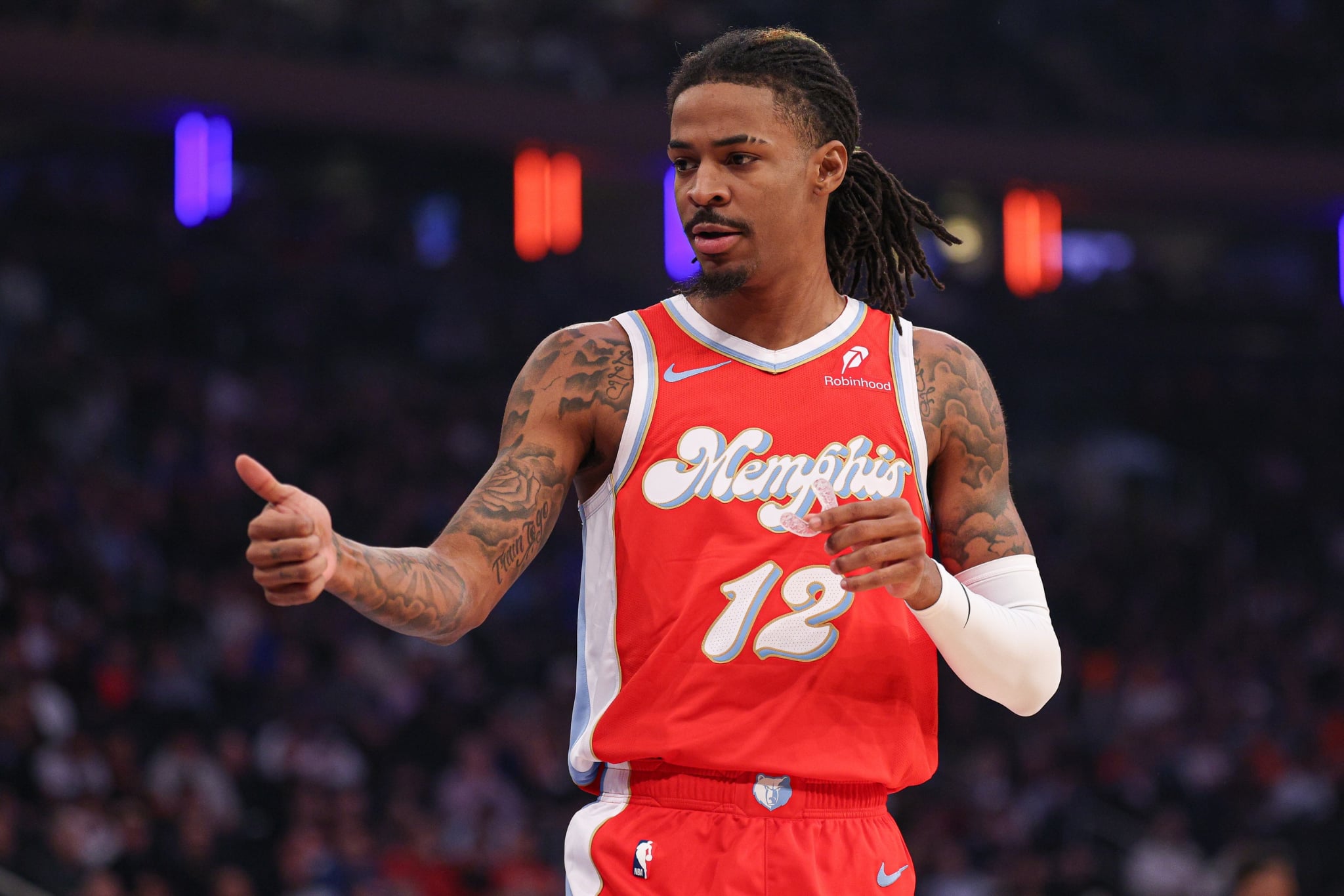
The Ja Morant era with the Grizzlies is over. Shams Charania reported that the Grizzlies traded Morant to the Blazers for Jerami Grant and Kris Murray, ending one of the weirdest star runs in the NBA.
Morant was supposed to be the franchise. Rookie of the Year. Most Improved Player. Two-time All-Star. Face of the Grizzlies. Then it went the other way fast. Injuries, suspensions, off-court trouble, poor shooting, bad team vibes, and finally a full franchise reset.
The Grizzlies already moved Jaren Jackson Jr. to the Jazz, drafted Cameron Boozer at No. 3, added Isaiah Stewart, and started building a new frontcourt around Boozer and Zach Edey. Trading Morant was always the next step if they wanted a full reset.
The surprise is the price, even with the Grizzlies struggling to move him all year long.
The Blazers are not giving up Scoot Henderson or Shaedon Sharpe. They are not giving up Deni Avdija, not even Donovan Clingan. They are not giving up a first-round pick either. They are sending Grant and Murray. That is wild for a 26-year-old guard who was still an All-NBA type player not long ago.
Morant is risky. No debate. He played only 20 games last season, averaged 19.5 points, 8.1 assists, and 3.3 rebounds, and shot only 41.0% from the field and 23.5% from three. That is ugly shooting. He also missed the rest of the season with a left elbow UCL sprain and had a suspension earlier in the year.
But this is still Ja Morant. He has career numbers of 22.4 points, 7.4 assists, and 4.6 rebounds. The burst, rim pressure, transition speed, and passing are still rare if his body is right. The Blazers just bought that upside without paying a normal star price.
Trade Details
Portland Trail Blazers Receive: Ja Morant
Memphis Grizzlies Receive: Jerami Grant, Kris Murray
Trail Blazers Grade: B+
This is a very good gamble for the Blazers. Not really a safe trade or a perfect fit with Henderson, Jrue Holiday, and Damian Lillard still in place. But the upside is too big compared to the price.
The Blazers went 42-40, finished eighth in the West, and lost to the Spurs in five games in the first round. That was already a good step, but the offense still needed a secondary creator. That is Morant’s job now.
The Blazers had a 114.4 offensive rating, 20th in the league, and shot 34.3% from three, 28th. Morant doesn’t fix the shooting. Actually, he makes that part harder because he hit only 23.5% from three last season. That is the main basketball problem.
But he fixes the rim pressure. The Blazers were first in drives per game at 59.6, but they still didn’t have one guard who scares defenses like Morant does when he is healthy, aside from Avdija at the wing. Morant bends the floor with speed. He forces help. He creates corner threes even if he isn’t making his own threes. That is different.
The best part is the cost. Grant is useful, but he was not a core player anymore. He had 18.6 points, 3.5 rebounds, and 2.1 assists in 57 games, with 45.3% from the field and 38.9% from three. That is good production, but he is 32, expensive, and not part of the long-term Blazers build.
Murray is a decent rotation forward, but not part of the planning. He had 5.8 points, 3.6 rebounds, and 1.4 assists in 57 games. He can defend, cut, and rebound a bit, but he is not the reason a team says no to Morant.
So the Blazers basically moved one expensive veteran forward and one low-usage wing for a two-time All-Star guard. That is why the grade has to be high.
There are problems, of course. The guard rotation is crowded. Holiday, Lillard, Morant, Henderson, and Sharpe can’t all have the same role. The Blazers have to make another move or accept that somebody is losing minutes. The defense also becomes trickier because Morant isn’t a stopper, and Lillard isn’t one either, as both are likely to start together, per ESPN.
Still, the Blazers didn’t pay the real star tax. They didn’t touch Avdija or Clingan. They didn’t move Sharpe. They didn’t move Scoot. They didn’t move a first-round pick. That is the whole win.
If Morant gets back even close to his old level, this trade becomes one of the best steal plays of the summer. If he stays hurt or the off-court stuff continues, it can get ugly fast. But the entry price is low enough to accept the risk.
Grizzlies Grade: D
This is a terrible return for the Grizzlies if there are no picks involved. It is hard to make it softer, even with the knowledge that his market was not particularly enticing.
Morant had issues. Everybody knows that. His value fell a lot. Brian Windhorst even reported during the season that Morant had negative trade value around the deadline. That is not normal for a 26-year-old former No. 2 pick with star production in his past.
But even with all that, Grant and Murray feels like a weak exit, more so with past reports of a potential wider market during the summer.
The Grizzlies went 25-57, finished 13th in the West, and already started a rebuild. That part makes sense. Trading Morant makes sense. The franchise needed a reset after the old core broke down. Morant, Jackson, Dillon Brooks, Desmond Bane, and the 2022 group are gone after an ugly falloff.
The problem is asset value. Grant is not a rebuilding asset. He is a veteran forward making big money. His salary is $32.0 million in 2026-27, with a $36.4 million player option in 2027-28. That is not cheap. For a team building around Boozer, Edey, Santi Aldama, Jaylen Wells, and young pieces, Grant is more of a salary bridge than a future piece.
Murray is fine, but he is not a major young player. He is already 25, and his offensive role is limited. He can be a seventh or eighth man if the shot improves, but that is not close to enough for a Morant trade.
The Grizzlies do get cleaner from a culture standpoint. That is the best argument. No more Morant drama. No more daily questions about his future. No more extension decision. No more trying to rebuild while the old franchise face sits in the middle of everything.
They also remove Morant’s $42.2 million and $44.9 million salaries from the books. That matters, but Grant’s deal still eats a lot of that space. This is not a full financial escape.
That is why the grade is low. If the Grizzlies had added one first-round pick, or even two seconds plus a swap, this would be easier to defend. Without that, it looks like they sold Morant at the absolute bottom.
Maybe they had no better offer. That is possible. Maybe teams were scared of the injuries, the suspensions, the elbow, the shooting, and the contract. But even if the market was bad, the return is still weak.
The Grizzlies turned a former franchise player into Grant and Murray. That is not enough. It may be the trade they had to make, but it is not a good trade.
Ja Morant Grade: B
This is a good move for Morant because he needed a new situation. Memphis was finished for him. Too much history. Too much noise. Too many injuries. Too many bad vibes around the team.
The Blazers give him a fresh start without the pressure of saving a terrible roster. That is important. The Blazers already made the playoffs. They already have real defenders. They already have wings. They already have a center. Morant doesn’t need to create an identity from zero.
The basketball fit is fun but not simple.
Morant with Avdija, Sharpe, Camara, and Clingan has real athletic upside. He can run, attack, throw lobs, and create paint touches. Clingan gives him a big target at the rim. Avdija gives him a forward who can push in transition and pass. Sharpe gives him a vertical scorer. Camara gives him defense on the wing.
That part is exciting.
The concern is spacing. Morant shot 23.5% from three last season. Henderson still isn’t a proven shooter. Clingan doesn’t stretch the floor. If the Blazers play two non-shooting guards or too many paint players, defenses will go under screens and pack the lane.
That is why Morant has to change something. He doesn’t need to become Stephen Curry. But he has to get back to at least playable shooting. His career three-point mark is 31.1%. If he gets near that again, the Blazers can survive. If he stays at 23.5%, playoff defenses will be brutal.
There is also the health part. The elbow injury ended his season, and he played only 20 games. The Blazers can’t grade this as a full win until he is actually on the floor. His rim pressure depends on speed and lift. If the body is not right, the whole trade changes.
Still, this is a good place for him. The Blazers are serious enough to compete, but not so loaded that he becomes a side piece. He can be a lead guard again. He can rebuild his value. He can show the league he is still a star and not just a risky contract.
His contract runs two more years, so this is also not a one-month audition. The Blazers get time. Morant gets time. That helps.
For Morant, this is probably one of the better outcomes. He gets out of Memphis, goes to a playoff team, and gets another chance to control the narrative with basketball.
Conclusion
This trade is all about risk pricing.
The Blazers are buying low on a star. The Grizzlies are selling low on a star. That is the whole story.
For the Blazers, this is easy to understand. They were a playoff team, but not a serious West threat. Morant gives them a ceiling they didn’t have with Grant. The cost is light, and the upside is huge. The shooting and off-court risk are real, but this is the type of gamble a 42-win team should take if it doesn’t cost top young players or first-round picks.
For the Grizzlies, it is harder. Trading Morant was probably necessary. The era was over. But the return is poor. Grant is useful, Murray is playable, but neither changes the future of the franchise. Unless there is hidden draft compensation not reported yet, this looks like a bad asset result.
For Morant, this is a reset. No excuses now. New team, playoff roster, clear role, two years left on the contract. If he plays well, the Blazers look smart. If not, the Grizzlies may look less crazy for moving him.