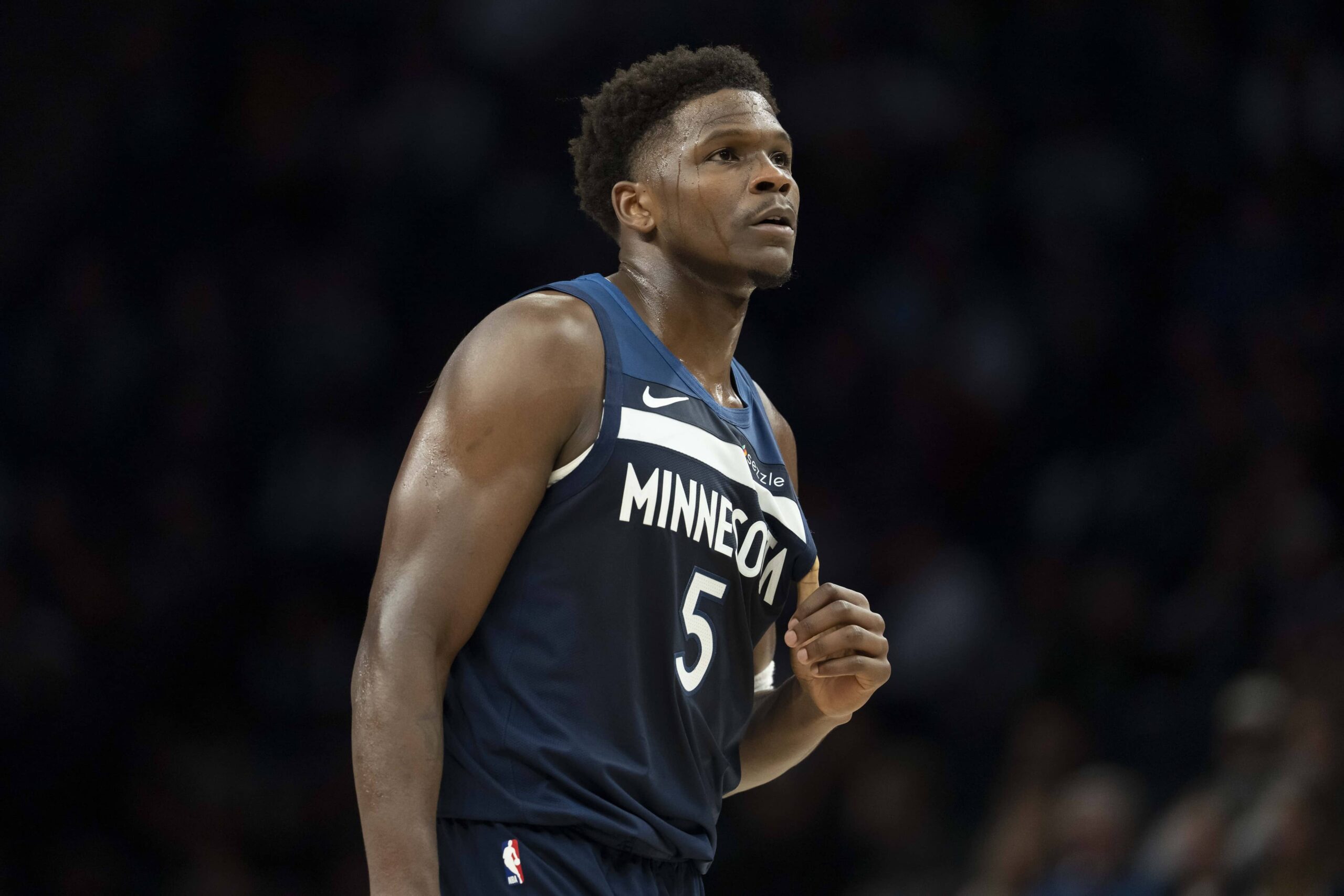
The Minnesota Timberwolves just made the biggest gamble of the NBA offseason so far. After trading Julius Randle and then following it up with a blockbuster deal for LaMelo Ball, Minnesota has dramatically altered the identity that made them one of the Western Conference’s toughest teams.
The Timberwolves are betting that LaMelo Ball‘s playmaking and scoring ability will unlock another level of Anthony Edwards‘ game.
But what if the trade creates more problems than it solves moving forward, regardless of what the Timberwolves GM thinks?
On paper, Ball and Edwards sound like a dream pairing. In reality, the Timberwolves gave up Naz Reid, multiple first-round assets, several second-round picks, and a significant portion of their roster flexibility.
More importantly, they may have sacrificed some of the qualities that helped turn Minnesota into a legitimate contender.
If Edwards is serious about winning championships, there are plenty of reasons he might not love this move.
1. Defensive Identity Is Gone
Minnesota’s rise in the West was built on defense. The Timberwolves finished 8th in defensive rating (113.5) because of their length, physicality, and ability to defend multiple positions.
They only allowed 114.6 PPG in a high-scoring league with a ton of threes being taken against them.
Rudy Gobert anchored the paint (11.5 RPG, 0.8 SPG, 1.6 BPG), Jaden McDaniels locked down opposing stars (1.1 SPG, 1.0 BPG), and Naz Reid provided valuable versatility off the bench (6.2 RPG, 1. 0 SPG, 1.0 BPG).
LaMelo Ball has never been known for his defense.
Over the last several seasons, the 6’7″ Ball has consistently posted below-average defensive metrics. For his career, Ball has a 113.9 defensive rating.
Opponents frequently target him in pick-and-roll situations, and his career defensive rating has often lagged behind that of elite guards.
While Ball generates steals, 1.2 SPG last season and a career 1.4 SPG, those numbers don’t always translate to strong overall defense.
Edwards has spent years developing into a legitimate two-way player. He posted 1.4 SPG and 0.8 BPG last season, posting a defensive rating of 113.8.
Bringing in Ball places additional pressure on Edwards, McDaniels, and Gobert to cover for another defensive liability.
Championship teams typically have weak links, and the Timberwolves just created a very obvious one.
2. Toughness Is No Longer A Strength
Minnesota used to intimidate teams, whether you believe it or not. The Timberwolves featured one of the league’s most physical frontcourts with Gobert (7’1″, 258 lbs), Reid (6’9″, 264 lbs), and Randle (6’9″, 250 lbs). That was the case when they had Karl-Anthony Towns (7’0″, 248 lbs) as well.
They consistently won battles on the glass, protected the rim, and wore opponents down over a seven-game playoff series.
Naz Reid’s value went far beyond his statistics. The consistent Sixth Man of the Year candidate averaged 13.6 PPG, 6.2 RPG, 2.2 APG, 1.0 SPG, and 1.0 BPG on 36.2% 3-PT FG last season.
His toughness gave the Minnesota lineup flexibility against larger opponents like Denver, Oklahoma City, and San Antonio.
Ball brings many skills, but physicality is not one of them. At approximately 180 pounds, Ball has often struggled with physical defenders throughout his career.
Meanwhile, Reid’s departure removes one of Minnesota’s most rugged and reliable contributors.
For a conference filled with Victor Wembanyama, Nikola Jokic, Alperen Sengun, Chet Holmgren, and Jaren Jackson Jr., losing toughness is a dangerous gamble.
Edwards has repeatedly talked about playing physical basketball, and the Timberwolves just became significantly less physical.
3. Sharing Shot Attempts With Another Ball-Dominant Star
Anthony Edwards will need his shot attempts as a top-10 player in the NBA right now. Over the last few seasons, Edwards has consistently averaged between 25 and 30 points per game while handling enormous offensive responsibility.
His usage rate has regularly ranked among the highest for NBA stars. Now enters LaMelo Ball.
Ball has averaged 17.5 FG attempts per game over his career, took 17.3 shots last season, and has two seasons averaging at least 20 shot attempts per game.
He also takes almost 9 threes per game, averaging 8.8, and taking 10.3 threes per game in 2025-26.
Edwards is averaging 19.0 field-goal attempts per game over his career and has taken at least 20.0 attempts per game over the last two seasons. Not to mention, he’s taking 8.0 threes per game.
Ball thrives with the ball in his hands and is most effective when controlling the game. That could be a steep learning curve next to Edwards.
While Ball’s passing should generate easier opportunities for Edwards, there is another side to the equation. Ball will take shots. A lot of them.
Edwards has spent years becoming Minnesota’s unquestioned alpha, but the Timberwolves just introduced another player who wants the ball constantly. Can Ball adjust to Edwards? We hope so.
4. Lack Of Size Will Hurt Against Western Conference Contenders
The projected lineup looks exciting, but it also looks smaller. The Timberwolves have to embrace full-on small-ball going forward.
- LaMelo Ball (6’7″)
- Anthony Edwards (6’4″)
- Ayo Dosunmu (6’4″)
- Jaden McDaniels (6’9″)
- Rudy Gobert (7’1″)
The issue is clearly frontcourt depth. Minnesota previously could throw Gobert, Reid, Randle, and McDaniels at opponents.
That gave them nearly 100 minutes of size every night. Now Reid and Randle are gone, leaving Gobert as the lone proven big man.
Look around the Western Conference, and the issue is clear. San Antonio has the intimidating Victor Wembanyama.
Oklahoma City rolls out Chet Holmgren and Jalen Williams. Denver still has Nikola Jokic. Houston features Alperen Sengun and a massive collection of athletic forwards.
Minnesota’s margin for error has shrunk considerably, and if the nearly-34-year-old Gobert misses time or gets into foul trouble, the Timberwolves suddenly look vulnerable in areas that were previously strengths.
5. Depth Is Now A Major Issue Unless Addressed
This may be the biggest concern of all because championship contenders need depth.
The Timberwolves have now traded away Julius Randle and Naz Reid while also surrendering future draft assets that could have been used in additional trades.
Their top-end talent may be stronger, but the supporting cast looks noticeably thinner.
Last season, Reid averaged 13.6 PPG while finishing top-five in Sixth Man of the Year voting in three straight seasons. Reid won Sixth Man of the Year in 2023-24, posting 13.5 PPG.
His ability to enter games and immediately produce offense often saved Minnesota during tough stretches. Replacing that production won’t be easy.
The bench now faces serious questions when looking at it. Under contract, there is Donte DiVincenzo (12.2 PPG, 4.1 RPG, 3.8 APG, 1.3 SPG, 0.4 BPG on 37.9% 3-PT FG), who just tore his Achilles tendon a handful of weeks ago.
Will the sharpshooter get back to full health as soon as next season?
Joan Beringer is 6’11” but only 19 years old, posting 3.9 PPG, 2.3 RPG, and 0.7 BPG in 7.9 MPG. Is he ready to play big minutes to help the aging Gobert?
We love Terrence Shannon Jr., a 25-year-old guard who posted 5.6 PPG in the regular season but 11.8 PPG in the playoffs.
But he is 6’6″, and is yet another guard the Timberwolves have to rely on to play bigger than he is.
Who becomes the backup center? Who supplies instant offense? Who provides frontcourt scoring if Gobert or McDaniels misses time?
These questions matter because injuries are inevitable over an 82-game season.
Edwards has carried massive workloads before, and if Minnesota doesn’t address its depth issues (mainly for forwards and bigs) through free agency or additional trades, he may be forced to do it again.
Final Thoughts: The Risk Is Real
LaMelo Ball is undeniably talented as a former All-Star. His passing, creativity, and offensive upside could help unlock another level of Minnesota’s offense.
If everything goes perfectly, the Timberwolves may become one of the most exciting teams in basketball.
But championships aren’t won on paper, and Edwards watched the franchise ship out the bigs he could trust to get stops, play hard, and feed off of him.
Sure, Julius Randle’s days were numbered after his poor playoff performances, but shipping him out without a replacement and then moving Naz Reid creates major holes.
While Ball’s talent is undeniable, Minnesota is asking Edwards to trust that offense will compensate for everything they lost, which is a difficult sell in our opinion.
And if the Timberwolves fall short next season, Edwards may have every right to wonder whether this blockbuster actually made them better.