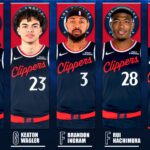
The Clippers are in a strange position before the 2026 NBA Draft. They have the No. 5 pick after the Ivica Zubac trade with the Pacers, but they are not really a top-five-pick team. This is still a roster trying to compete. They went 42-40, finished ninth in the West, and still have Kawhi Leonard, Darius Garland, Bennedict Mathurin, Derrick Jones Jr., and enough veteran talent to think about winning now.
That is why the No. 5 pick becomes such an interesting asset. The Clippers can keep it and take the best guard or wing available. But they also have clear roster problems. They need a center. They need more size. They need rim protection. And more than anything, they need to build a team that helps Leonard in his final year, not only a team that looks better in 2029.
The Bucks are in a different kind of situation after trading Giannis Antetokounmpo to the Heat. They got Tyler Herro, Kel’el Ware, Jaime Jaquez Jr., Kasparas Jakucionis, the No. 13 pick, and future picks. That is a serious reset, but the reset still needs a main young prospect. No. 10 and No. 13 are useful picks, but No. 5 gives them a better chance at finding a real franchise-building block.
This mock trade gives both teams a clearer direction.
Potential Trade Offer
Milwaukee Bucks Receive: No. 5 pick, Bogdan Bogdanovic, Isaiah Jackson
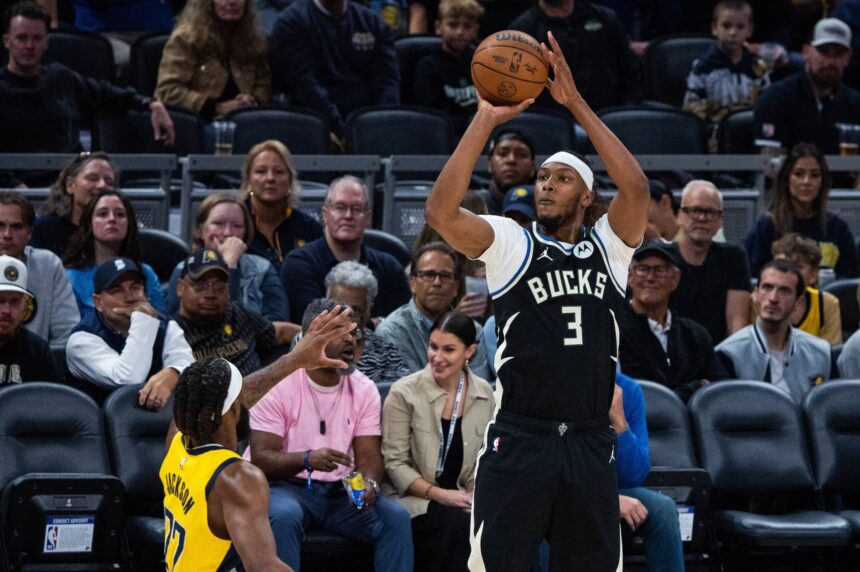
Los Angeles Clippers Receive: Myles Turner, No. 10 pick, No. 13 pick
The deal is pretty simple. The Bucks move up from Nos. 10 and 13 to No. 5. The Clippers go down five spots, add another lottery pick, and get Myles Turner as their new starting center.
The salary part is close enough to make it a real framework. Turner is owed $26.6 million in 2026-27. Bogdan Bogdanovic is at $16.0 million on a club option, and Isaiah Jackson is at $7.0 million. That puts $23.0 million going back to Milwaukee. There may be some smaller cap details to clean up depending on apron rules and timing, but the base idea is workable.
The basketball logic is even stronger.
Turner averaged 11.9 points, 5.3 rebounds, 1.5 assists, and 1.6 blocks last season. His scoring went down, but he still shot 38.3% from three on 5.4 attempts per game. That shooting is the key part for the Clippers. Garland and Leonard both need space. Turner gives them a center who can pull another big man away from the paint.
For Milwaukee, Turner no longer makes the same level of sense. He was signed to play next to Giannis. Without Giannis, his value to the Bucks changes. They should now be focused on Herro, Ware, Jaquez, Jakucionis, and the best draft asset they can get.
Why The Bucks Would Move Up To No. 5
The Bucks need a new high-end prospect after the Giannis trade. That is the main reason for this move.
No. 10 and No. 13 are good picks, but when a team is rebuilding, quality usually matters more than quantity at the top of the draft. Milwaukee already has several young pieces. What it needs now is someone who can become the face of the new core.
The realistic board at No. 5 matters here. AJ Dybantsa, Darryn Peterson, Cameron Boozer, and Caleb Wilson should be gone by then. So the Bucks are probably not trading up for one of the top-four names. They are trading up for the next tier. But that next tier still has real value.
Keaton Wagler looks like the target. NBA.com’s mock had him as the most common No. 5 pick, and the fit is easy to understand. Wagler averaged 17.9 points, 5.1 rebounds, and 4.2 assists at Illinois while shooting 44.5% from the field and 39.7% from three. At 6-foot-6, he can play off the ball, shoot off movement, and give the Bucks another creator with size.
The Bucks already have Herro and Jakucionis as ball-handling pieces. Wagler would not need to run every possession. He can play as a bigger guard next to Herro, attack closeouts, and keep the offense moving without forcing everything. His shooting is also very important because Ware and Jaquez will need space around them.
Darius Acuff Jr. is another option if Milwaukee wants more pure point guard creation. Acuff averaged 23.5 points, 3.1 rebounds, and 6.4 assists at Arkansas while shooting 48.4% from the field and 44.0% from three. Those are serious numbers. He would give the Bucks more speed, more pick-and-roll scoring, and a real lead-guard path.
The question with Acuff is fit. He is more ball-dominant than Wagler, and Milwaukee already has Herro. That does not mean Acuff is a bad pick. It just changes the direction. Acuff would push the Bucks toward a smaller and faster guard-led offense. Wagler gives them more lineup flexibility.
Mikel Brown Jr. is the third name to watch if the board goes a different way. He averaged 18.2 points, 3.3 rebounds, and 4.7 assists at Louisville. The efficiency was not perfect at 41.0% from the field and 34.4% from three, and the back injury adds some risk. Still, the passing, pull-up shooting, and guard skill are real. He would give Milwaukee another creator who can grow with the rest of the young core.
That is why moving up makes sense. No. 10 and No. 13 could bring two good players, but the Bucks already have a lot of young players who need development. Ware needs minutes. Jaquez needs touches. Jakucionis needs on-ball reps. Herro needs shots. Adding two more lottery rookies could become crowded very fast.
No. 5 gives them one better swing. Wagler should probably be the target because of the size, shooting, and fit. Acuff is the higher-usage guard option. Brown is the riskier skill bet. But in all cases, Milwaukee gets closer to finding a new main piece for the rebuild.
Bogdanovic is not the prize of the trade, but he is not useless either. He averaged 7.4 points, 2.6 rebounds, and 2.2 assists for the Clippers while shooting 34.7% from three. It was a down year, but he is still a career 38.1% three-point shooter. The Bucks could keep him as a veteran spacer, move him later, or just use the short-term salary to stay flexible.
Jackson is more interesting for their timeline. He averaged 7.5 points, 4.6 rebounds, and 1.2 blocks in 15.9 minutes with the Clippers. He shot 76.4% from the field and had a 74.1 true shooting percentage. The volume was low, but his role is clear. He runs, jumps, finishes lobs, rebounds, and blocks shots.
As a backup behind Ware, that is fine. Jackson is only 24, makes $7.0 million, and gives the Bucks another athletic frontcourt player. He does not shoot, so he cannot fit in every lineup, but rebuilding teams can use cheap energy bigs.
Milwaukee would be paying a real price here. Giving up Turner, No. 10, and No. 13 is not small. But after trading Giannis, the Bucks cannot be too careful with upside. They need a new direction, and No. 5 gives them a cleaner chance at that than two later lottery picks.
Why The Clippers Would Trade Down For Turner And Two Lottery Picks
The Clippers should not trade No. 5 for Turner alone. That would be too much. Turner is a good player, but at this point, he is not worth a top-five pick by himself.
This deal works because the Clippers get Turner and still stay in the lottery twice.
Moving from No. 5 to No. 10 and No. 13 is a real drop, but it is not like the Clippers are leaving the draft. They would still have two chances to add useful young players. They could take one upside guard and one wing. They could take one shooter and one defender. They could also use one of those picks in another trade. For a team trying to win now while also needing cheap young talent, that is a strong position.
Turner fills the biggest basketball hole.
The Clippers were 42-40 with a +1.2 net rating, but the profile was not strong enough. They ranked 24th in points per game at 113.8, 29th in rebounds per game at 40.6, and 30th in assists per game at 23.7. Their defense was better than their offense by raw points allowed, but after moving Zubac, they still needed a real center.
Turner gives them that without hurting spacing.
He made 2.1 threes per game last season and shot 38.3% from deep. That is very useful next to Garland and Leonard. Garland needs room for high ball screens, pull-up threes, and pocket passes. Leonard needs space to reach the midrange without another big defender waiting in the lane. Turner helps both of them.
A Garland-Turner pick-and-pop could work right away. Garland averaged 19.9 points and 6.4 assists after landing with the Clippers. He can force the defense to step up, and Turner can either pop to the three-point line or slip into open space. It is a simple action, but it becomes difficult to guard when Leonard is one pass away.
Turner also gives the Clippers real rim protection. He had 1.6 blocks per game last season and has averaged 2.1 blocks for his career. He is not an elite rebounder, and that is a concern. The Clippers were already weak on the glass, so Turner alone does not fix everything. But he gives them a vertical defender they did not really have after the Zubac trade.
The Clippers also have to think about Leonard. He averaged 28.0 points, 6.3 rebounds, and 3.0 assists last season. When he is on the floor, he is still one of the best half-court scorers in the league. But they cannot keep asking him to carry lineups that do not fit well. Turner gives him a better frontcourt partner.
Bennedict Mathurin is another reason this deal makes sense. He averaged 17.4 points, 5.5 rebounds, and 2.5 assists in 26 games with the Clippers after the trade, but he shot only 20.7% from three. That spacing issue makes Turner more valuable. If Mathurin is attacking downhill and not spacing the floor well, the center cannot also be a non-shooter. Turner keeps the lane more open.
The No. 10 and No. 13 picks make the trade safer. The Clippers still get youth. If Wagler is gone at No. 5, the gap between No. 5 and No. 10 may not be big enough to turn down Turner and another lottery pick. At No. 10 and No. 13, they can still target a guard, forward, or shooter who fits the Leonard-Garland timeline without needing star-level touches right away.
That is the best part of the deal for the Clippers. This is not a full win-now panic trade. It is a win-now move with a draft safety net. The Clippers get their center and still keep two lottery shots. Of course, the risk is real.
Turner is 30 and makes $26.6 million next season. His scoring dropped from 15.6 points in 2024-25 to 11.9 points in 2025-26. His 44.0% shooting from the field is also low for a center. If the decline is real and not just a product of a bad situation in Milwaukee, the Clippers could regret giving up the No. 5 pick.
But the fit is good enough to take seriously. Turner does not need to be a 20-point scorer for the Clippers. He needs to space the floor, block shots, screen, finish plays, and stay healthy. That role is realistic for him.
For both sides, this trade has a clear purpose. The Bucks get one better draft swing after starting over. The Clippers get a starting center and two lottery picks instead of waiting on one rookie at No. 5.