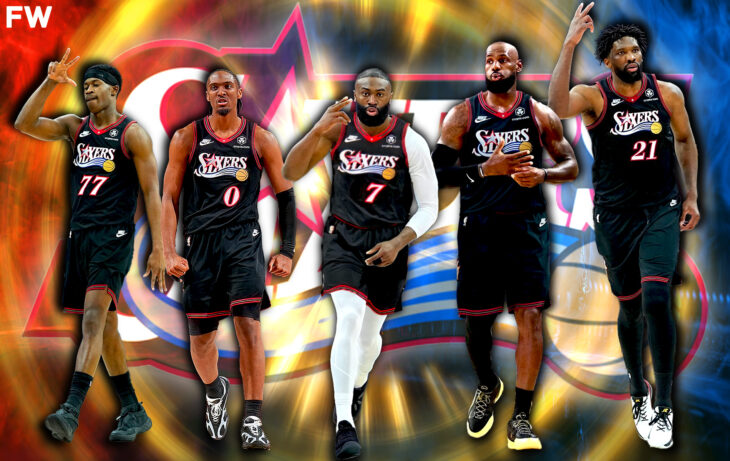
Jaylen Brown landing in Philadelphia changes the feel of this 76ers roster in a way we couldn’t have expected at all. It gives them a two-way wing who can actually carry weight in the playoffs next to Embiid and Maxey instead of an injury-riddled Paul George.
Before this, they always felt like a team that needed one more thing to be truly dangerous. Now they have that thing, and it shows up in how the East looks at them.
The trade itself was shocking, to say the least. Philadelphia sent Paul George, the 2028 and 2031 first-round picks, and two second-round picks to Boston for Brown. The Celtics had been shopping him around after they struck out on Giannis, and the 76ers moved fast.
Brown didn’t ask out, but once it became clear he was available, Philadelphia jumped on it. Now he’s in the same squad as Embiid, Maxey, and VJ Edgecombe, and that alone shifts the power balance in the East.
It doesn’t make them the best team overnight. The Knicks are still the defending champions, and they were absurd last season statistically. But Brown moves Philadelphia closer to that tier than they were before, and that’s the real story here.
Brown Gives The 76ers An Elite Playoff Wing
Brown just came off a 28.7 points, 6.9 rebounds, 5.1 assists season on 47.7% shooting. He was sixth in MVP voting, made the All-NBA Second Team, and he’s walking into Philadelphia as a five-time All-Star with a Finals MVP already on his résumé. That’s a different level of player than what Paul George had become in his two injury-plagued seasons there.
George still has the name, but the production had dropped off to 17.3 points last year. Brown is entering his prime and brings downhill force that the 76ers haven’t really had next to Embiid. He can attack a tilted defense, punish switches, and take the tougher defensive assignment without it being a total mismatch.
That matters against teams like the Knicks. Last year’s second-round sweep exposed how thin the 76ers were on the wing once things got physical. Brown doesn’t fix every problem, but he gives them a third creator who can actually hold up when the game slows down and the defense gets set.
Maxey And Brown Together Look Nasty
This pairing makes the 76ers feel like a revamped team on both sides of the court. Tyrese Maxey was already playing like an All-NBA guard last season. He put up 28.3 points, 4.1 rebounds, and 6.6 assists in 70 games, finishing fifth in the league in scoring and 15th in assists.
What stood out even more was how clean he played with that kind of usage: 46.2% from the field, 36.7% from three, 89.2% from the line, and a 58.8% true shooting mark, all while only turning it over 2.4 times in 38 minutes. That gave him a 2.75 assist-to-turnover ratio as a high-usage guard, which isn’t normal. He wasn’t just fast and explosive; he was producing at volume without bleeding possessions.
The 76ers were already a pretty controlled offensive team last season. They ranked 19th in offensive rating but 14th in points per game, ninth in effective field goal percentage at 51.4%, third in turnover percentage at 12.8%, and fifth in assist-to-turnover ratio at 1.8. So it wasn’t like they were a mess with the ball. They just needed another real pressure player when the first action got stopped. That’s where Jaylen Brown changes things.
Brown came in averaging 28.7 points, 6.9 rebounds, and 5.1 assists while shooting 47.7% from the field. He finished fourth in the league in scoring, and he did it with a 57.3% true shooting mark. He’s not just a scorer either, since he brings defensive effort and enough playmaking to attack an already tilted defense.
What makes the Maxey-Brown pairing so dangerous is how different they are as creators. Maxey creates panic with his speed. He turns a simple high screen into a rim touch, a pull-up three, or a kickout before the defense can even get set. Brown creates a different kind of problem. He plays through contact, shoulder pressure, and downhill force. If teams put a smaller guard on him, he can go right into the body. If they load up early on Maxey, Brown attacks the tilted floor before the low man can recover.
Together, they combined for 57.0 points, 11.0 assists, and 11.0 rebounds per game last season. That’s before you even add Embiid’s 26.9 points and his gravity in the half-court. A defense can trap Maxey, but then Brown gets an open shot or a drive to the basket. They can send help at Brown, but then Maxey is one pass away with the defense already moving. They can double Embiid, but the first pass out is going to a 28-point guard or a 28-point wing. That’s a much tougher cover than what the 76ers had before.
The turnover side is also very helpful, even if it’s not the main attraction. Maxey’s 2.4 turnovers with 6.6 assists gives them a lead guard who can run a high-volume offense without turning the game into chaos. Brown isn’t a pure point forward, but 5.1 assists from a scoring wing are enough to punish overhelp. Since the 76ers already ranked third in the league in turnover percentage, adding Brown shouldn’t mess with their possession control if he’s used the right way.
It also improves how they play in transition. Maxey is one of the fastest pressure guards in the league, and Brown is very good when he gets the ball before the defense is set. With both in the mix, the 76ers don’t have to play every possession through a slow Embiid touch anymore. They can get stops and push, whether it’s through Maxey in transition or Brown grabbing a rebound and attacking before the matchup is set.
The half-court stuff is probably where Brown helps the most. Last season, when Maxey got trapped or things slowed down, the 76ers would often end up taking tougher shots than they wanted. They weren’t terrible at it, but they were clearly a step behind teams like the Knicks when it came to generating good looks in those moments.
What makes it work is how different they are. Maxey stresses defenses with his speed and shooting. Brown stresses them with his strength and downhill game. And Embiid is still sitting there in the middle as the biggest problem of all. Together, they create three different kinds of issues for a defense to deal with on the same possession.
Joel Embiid Is Still The Whole Thing
None of this becomes a real title formula if Joel Embiid isn’t healthy and playing like himself when the series gets serious. That’s still the big uncomfortable truth sitting underneath everything. Brown makes the roster deeper and gives them another real creator; Maxey brings speed and shot creation, and VJ Edgecombe adds another athletic piece on the wing. But the whole thing still starts and ends with Embiid’s gravity, his free-throw pressure, and his ability to slow the game down in the half-court.
The advanced numbers show how much he actually moves the needle. With Embiid on the floor last season, the 76ers had a 118.5 offensive rating and a +3.7 net rating. Their defensive rating with him was 114.8, which was better than the team’s full-season mark. For context, their offensive rating without him was much closer to their season-long 115.4.
Embiid posted a 60.5% true shooting mark, a 24.7 PER, and a .481 free-throw rate while going +155 in 1,201 minutes. That free-throw rate is the part that really matters, because it shows how much he still bends defenses just by being in the paint. Brown and Maxey can create more movement around him, but Embiid is still the one who changes the outcome of a playoff series.
Brown’s real value in the regular season is that Embiid shouldn’t have to carry every ugly Tuesday night anymore. With another high-level wing scorer next to Maxey, the 76ers can survive more non-Embiid minutes without the offense completely falling apart. That should help him manage his minutes better and, ideally, enter April with his legs and defensive mobility still intact.
In the playoffs though, the standard is much stricter. Against teams like the Knicks, Heat, Raptors, or Pistons, Embiid has to be a two-way anchor, not just a scorer. He needs to punish switches, make the right reads against doubles, protect the paint, and stay mobile enough in pick-and-roll coverage. His career playoff fourth-quarter true shooting sits at 53.2%, and that number is exactly why they needed Brown so badly. They needed another late-game creator so every hard possession doesn’t turn into Embiid trying to bulldoze through two bodies with tired legs.
The Defense Improves, But Questions Remain
Brown makes the 76ers better on the perimeter right away, and it’s not just that he has size. He posted a +2.2 total EPM last season, which put him in the 89th percentile, and he did that while playing with a 35.2% usage rate, 99th percentile. Even with all that offensive responsibility, his defensive EPM was basically league average at -0.1.
Not the most amazing numbers, but he wasn’t getting cooked every night despite carrying a huge scoring load. In Philadelphia, he shouldn’t have to do everything on offense like he did in Boston with Tatum out, so he should be able to use more energy on the toughest wing matchups. That alone changes how the defense feels.
Dean Wade coming into the team after free agency helps for different reasons. He’s not just a tall shooter. At 6-foot-9 with a 6-foot-10 wingspan, he’s switchable enough that the Cavaliers trusted him to start 14 of their 18 playoff games last season.
His box score was quiet at 4.4 points and 3.9 rebounds, but that’s not why they played him. He defended, he spaced, and he kept lineups from looking awkward. The number that actually stands out is the +5.0 net rating Cleveland had with him in the playoffs, which was the best mark on the team. That’s the kind of low-maintenance, high-floor forward the 76ers needed next to guys who want the ball a lot.
The closing group now has a clearer shape: Maxey, Edgecombe, Brown, Wade, and Embiid. Maxey is still small, but he’s no longer surrounded by weak wing size. Brown brings 6.9 rebounds per game from the wing, Wade adds 4.2 rebounds and 36.2% from three, and Edgecombe gives them athletic pressure even if he’s still figuring out playoff coverages. The 76ers had a 115.5 defensive rating last season, while the Heat sat at 114.5 and the Knicks were 7th at 113.3. So yeah, Philadelphia got better on that end, but there’s still a gap between the top teams.
The Spacing Is Suddenly Getting Better
The 76ers have spacing now, but it’s not quite at the level of the Celtics or the Knicks yet. It’s functional playoff spacing that works when everything else is moving, not the kind where defenses are glued to their men from 28 feet no matter what.
Maxey is still the main reason it functions. He shot 36.7% from three on 8.6 attempts and made 3.1 threes per game last season, which is real high-volume pull-up pressure rather than just standing in the corner. Wade helps at 36.2% from three as a 6-foot-9 forward, and Embiid at 33.3% from three is fine for a center, but the 76ers can’t still be considered a sharpshooting team.
You can see the gap in the team numbers. The 76ers weren’t that impressive in effective field goal percentage at 51.4%, while also sitting 10th in assist ratio at 16.6. It’s a controlled, structured offense, but it’s still a step behind the Knicks, who posted a 56.6% effective field goal percentage. That difference is big, and it’s why Philadelphia still has to prove their shooting can hold up against top-tier defenses.
Brown helps in a different way. Because he averaged 28.7 points on 47.7% shooting with a 57.3% true shooting mark, defenses can’t just sag off him like a role player. If they help too much, he can attack the closeout. If they switch a guard onto him, he goes right into the body. It’s not pure shooting spacing, but it’s his gravity that forces defenses to stay honest and gives the offense more edge.
The real swing piece is still Edgecombe. As a rookie, he put up 16.0 points, 5.6 rebounds, and 4.2 assists, which is strong, but in the playoffs, his three-point shooting dropped to 29.2%, and his true shooting was only 50.4%. That’s the number good defenses are going to remember. They’ll keep helping off him until he makes them pay, and in the playoffs, he just has to make that step forward.
So… Are They Title Favorites?
The 76ers are suddenly a top title contender, but I don’t think they’re the favorites yet. They’re a big threat now, and that’s a meaningful step, but they’re not at the top of the East just yet.
The betting markets seem to agree with that read. After the trade, their title odds dropped from 60-1 all the way to 22-1, and their odds to win the East improved quite a bit. It’s a big move in the right direction, but it still leaves them behind the Knicks and the new-look Heat.
And honestly, that feels right to me. They have a really loaded top end now with Maxey, Brown, Edgecombe, and Embiid. That’s a lot of talent. But being a true title favorite takes more than just star power. It takes durability, a clear defensive identity, and the ability to execute when games get physical and ugly. The 76ers are still working on some of those things.
If Embiid can stay healthy and play around 60 games or more, then yeah, I think they have a legitimate shot to win the East. Brown finally gives them the kind of wing they’ve been missing for years, and that changes how dangerous they can be in a playoff series. But if Embiid’s body breaks down again, none of these additions are enough to carry them through a long postseason run.
The 76ers found the missing piece. Now comes the part that has always been harder for them: staying healthy, fitting it all together, and getting to the promised land in June.