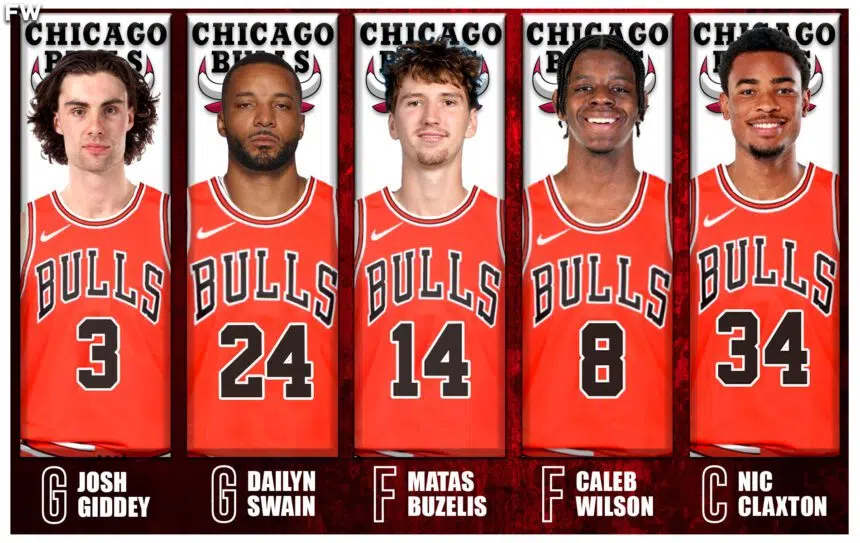
The Bulls came into free agency in an odd spot. They weren’t pretending to be a team ready to compete in the East, and nobody was treating them like one either. They were coming off a 31-51 season, with a new voice in the front office and Tiago Splitter as the new coach after Billy Donovan left. The roster was clearly in rebuild mode even at the midpoint of the 2025-26 season, focused more on size, youth, and keeping options open than on making noise in the postseason.
That’s what made their offseason more interesting than it looked at first glance, as there definitely wasn’t that much expectation on them making any type of hyped moves. While they didn’t go chasing big names or try to force something that wasn’t there, the Bulls used their cap space on Nic Claxton, brought back Zach Collins, and spent the rest on Norman Powell. It wasn’t flashy, but it feels like finally something is grooving in Chicago for the future.
Here’s how their moves graded out.
Acquiring Nic Claxton
Grade: A-
The Bulls picked up Nic Claxton in the three-team deal that sent Julius Randle to the Nets. They took on his $23.3 million salary, but they didn’t have to give up much of value to do it.
They basically used their cap space to absorb him instead of just throwing money at free agents. That’s usually a smart way to operate when you have room and another team is looking for an out for a big contract.
Claxton is 27 and still has two years left on his deal, so he fits the timeline better than some veteran who would have clogged their development. Claxton posted 11.7 points, 6.9 rebounds, 3.7 assists, and 1.1 blocks last season while shooting 57% from the field. The assist number jumped, which matters for a team that has Giddey and a bunch of young forwards who’ll need some help keeping the offense from getting stagnant.
On the court, he finally lands them a legitimate defensive center who can switch, run the floor, and finish above the rim. That’s something the Bulls have been missing. Matas Buzelis and new rookie Caleb Wilson should benefit from having an actual rim protector behind them instead of just hoping the other guys figure it out on their own.
Claxton’s not perfect. He’s not a shooter, and he had a down year on the glass. But for what they gave up, this was a solid get. They got a starting-caliber center without attaching picks or overpaying in free agency. That’s a win for where they’re at.
Re-Signing Zach Collins
Grade: B-
Zach Collins agreed to a two-year, $17 million deal with a team option on the second year. That second-year option is probably the most important detail here. Collins has a long injury history, and last season he only played 10 games before toe surgery shut him down.
When he’s healthy, Collins is a functional backup big man. He can stretch the floor a bit, pass out of the short roll, and play both center and power forward depending on the matchup. He averaged 9.7 points and 5.6 rebounds in limited minutes last season.
The money is the part that keeps this from feeling like a better move. $8.5 million a year is a lot for a player who barely played last season. Even with the team option softening the risk, it still feels like they’re paying for potential availability more than proven production.
At the end of the day, it’s a fine signing. It gives Tiago Splitter another experienced body to work with while Matas Buzelis, Caleb Wilson, and the rest of the young frontcourt develop. It’s not exciting, and it’s not something that moves the needle much, but it’s also not a bad use of resources if you accept that Collins is just a bridge piece.
Signing Norman Powell
Grade: B+
This was the move that actually made their free agency feel like something special is brewing out of the Windy City. Norman Powell signed a two-year, $45 million deal with a team option on the second year after an All-Star season with the Heat. He averaged 21.7 points last season while shooting 38% from three.
The obvious question is why a 31-win team is paying a 33-year-old scorer that kind of money. It’s a fair point. The Bulls aren’t suddenly a playoff team because of this, but Powell is at least a good piece to keep while making the roster more competitive. He gives them a veteran who can score and space the floor while Wilson, Buzelis, Swain, and Essengue are still figuring things out.
When you have a bunch of young guys still figuring things out, possessions can turn into late-clock scrambles way too often. Having a veteran scorer who can actually make good decisions in those moments keeps the offense from getting too ugly on the nights when the rookies aren’t ready yet. He also works well next to Giddey. He can shoot off the catch, attack closeouts, and doesn’t need to hold the ball for long stretches.
The deal isn’t a trap either. The team option in year two gives them flexibility. If Powell plays well, they can always move him. If he helps the young guys develop and the team gets a little better, that works too. It’s a smart use of cap space for where they are.
Letting Collin Sexton Leave
Grade: C+
The Bulls let Collin Sexton walk to the Lakers on a two-year, $19 million deal after he spent the second half of last season in Chicago. They originally picked him up at the deadline in the Coby White trade, which means they essentially turned White into Sexton (on a short-term rental) and a few second-round picks. Then they watched Sexton leave for relatively cheap money without getting a return. That part doesn’t look great in hindsight.
Sexton averaged 15.4 points while shooting 40% from three last season. On a two-year, $19 million contract, that’s solid, low-risk production for a team that needs scoring. The Bulls already committed money to Norman Powell and have Giddey, Tre Jones, and Rob Dillingham on the roster, so maybe they decided they didn’t want another guard who needs the ball in his hands. Still, letting a productive scorer walk for that price feels like they left something on the table, especially after giving up White to get him in the first place.
Sexton isn’t a difference maker, but he can get downhill, create his own shot, and play at a decent level without needing a huge role. Those types of guards aren’t easy to find at $9–10 million per year. The Bulls might have felt like they already had enough creation on the perimeter after adding Powell, but it still feels like they could’ve at least tried to keep him or gotten more value out of the situation.
It’s not a terrible decision on its own, but when you connect it back to the White trade, it leaves a bit of a sour taste. It’s the one move that feels like they didn’t quite maximize what they had.
Overall Free Agency Grade: B+
The Bulls’ offseason wasn’t flashy, but it was at least more coherent than what they’ve done in recent years. They used their cap space on Claxton instead of just chasing names, added Powell on a deal that still gives them some flexibility, and kept Collins without locking themselves in too deep. They also let Sexton walk rather than overcrowding the backcourt after already committing money to Powell. It wasn’t all perfect, but there was at least some good logic behind the decisions.
There are still obvious issues, though. Collins’ injury history remains a concern, Powell is already 33 on a team that probably needs more patience than a few extra wins right now, and they still don’t have that top-end talent that actually moves the needle for a franchise. That part hasn’t changed.
Even so, this summer felt different because they actually operated with a direction instead of just making random moves to fill space. After absorbing Nic Claxton’s full $23.3 million salary in the three-team trade and signing Norman Powell to a two-year, $45 million deal, the Bulls are now over the salary cap. However, they remain well below the first apron and didn’t hard-cap themselves, which is important.
According to current projections, they still have the Room Mid-Level Exception available (around $9.4 million) and enough flexibility to make future moves without being completely restricted. They didn’t burn through all their cap space on long-term commitments, and the team option on Powell’s second year gives them another layer of control.
For a rebuilding team, that’s meaningful. They can still absorb salary in trades if something interesting comes up, and they avoided the kind of rigid cap situation that can haunt teams for multiple seasons. It’s not a ton of room, but it’s enough to keep options open while they continue developing their young core.