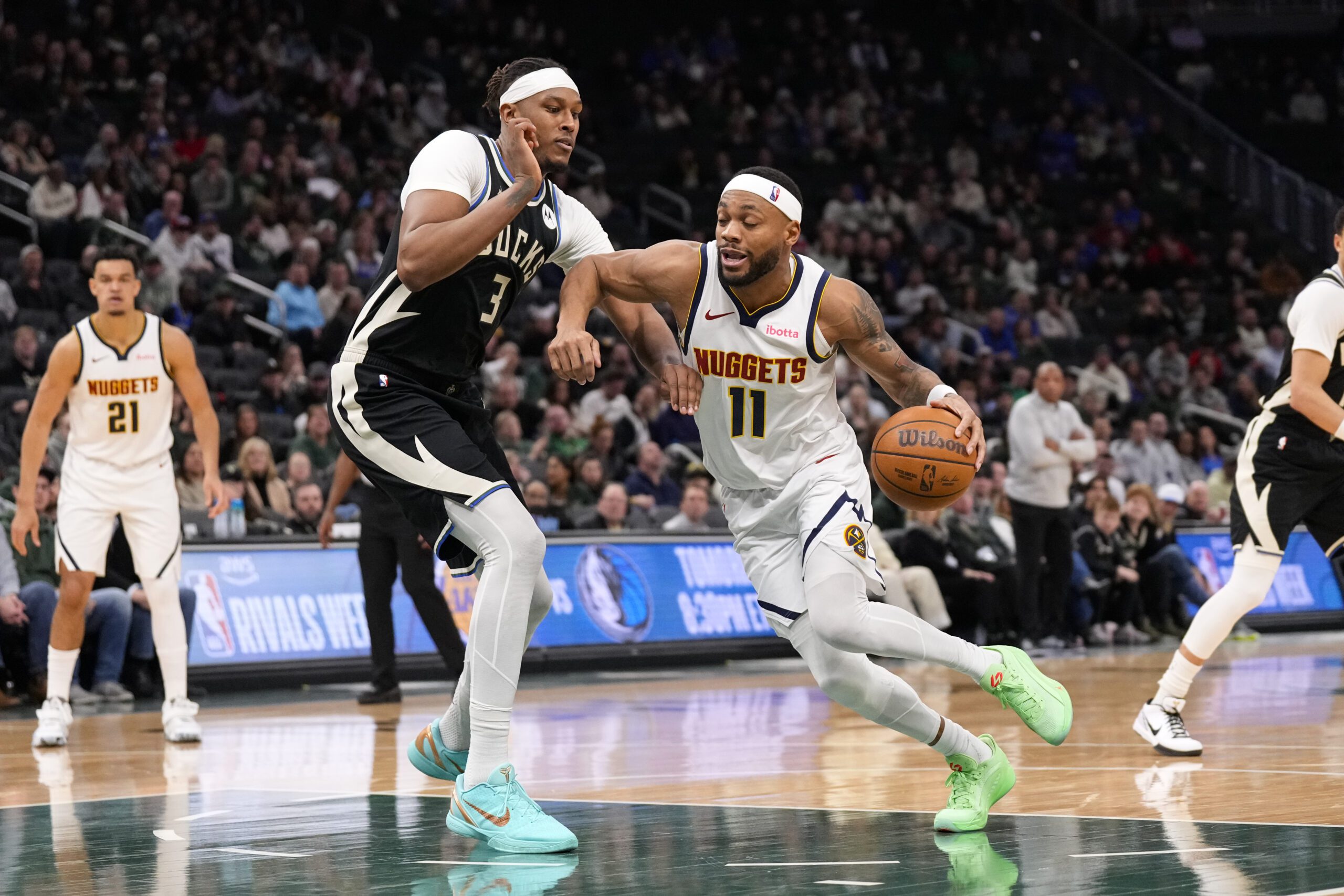
Bruce Brown Jr. is one of those free agents who still makes sense for many playoff teams because his game is easy to plug into a rotation. Last season with the Nuggets, Brown played all 82 games, averaged 7.9 points, 3.9 rebounds, 2.1 assists, and 1.0 steals in 24.4 minutes, while shooting 47.5% from the field, 38.5% from three, and 76.2% at the line.
Brown will never give a team some star production, but he’ll always bring great bench value from a guard who can defend, rebound, cut, screen, push the ball, and thrive in different lineup types.
Brown signed a one-year, $3.1 million deal with the Nuggets last summer, so he can pick his next spot without any restricted free agency problem. The Nuggets can still be an option because Brown already knows the system, and he may be the most likely Nuggets free agent to return, but this is also the kind of veteran who should get calls from teams needing one more guard-wing connector.
Brown’s value comes down to fit, contract, and role within a contender’s rotation. After making $45.0 million from the Pacers in 2023, his market is now much closer to a minimum or exception-level deal. That makes him interesting for many contending squads. He is not a savior, but for the right team, he can still be the eighth or ninth man who closes some playoff quarters because he does many things to help.
5. Brooklyn Nets
Brooklyn’s fit for Bruce Brown has more to do with money and playing time than with actually contending, which makes sense given where the Nets are in their rebuild. Brown played the best role-player basketball of his career in Brooklyn before winning a title with Denver, and this version of the Nets can offer him something most contenders simply can’t right now: a bigger role, consistent minutes, and a contract that beats the minimum.
Start with the roster itself. Brooklyn finished 20-62 last season, landed 13th in the East, and posted one of the weakest scoring offenses in the league at 105.9 points per game. That’s not a pretty picture, but it also explains exactly why the Nets should be hunting for veterans who can play real NBA minutes without derailing the development of their young guards.
The wrinkle here is that the Nets already signed Keon Ellis to a two-year, $18 million deal, which makes adding Brown a little less needed than it once looked. Ellis averaged 6.7 points, 1.0 assists, and 1.2 steals in 20.5 minutes last season, shooting 44/36/73, and he already gives Jordi Fernandez a point-of-attack defender on the roster.
The financial picture with the Nets isn’t only cap space anymore. They already used their flexibility to take on bigger forward money. Michael Porter Jr. is on the books at $40.8 million for 2026-27, and the Nets also added Julius Randle in the three-team deal that sent Nic Claxton to the Bulls. Randle is at $33.3 million next season, with a $35.8 million player option for 2027-28.
Brown wouldn’t be coming into an empty rebuild with minutes everywhere. He would be joining a roster that already has Porter as a high-usage scorer after a 24.2-point, 7.1-rebound, 3.0-assist season, and Randle as another frontcourt creator after averaging 21.1 points, 6.7 rebounds, and 5.0 assists. The Nets still have some room to work around $25 million in cap space after their moves, but Brown would have to be a small-contract play, not a priority spend.
This obviously isn’t the best championship path available to Brown. It’s not close, honestly. But if he’s looking for a familiar organization, real playing time, and a bigger paycheck than the minimum, Brooklyn should be in the conversation.
4. Golden State Warriors
Golden State’s interest here cooled off once De’Anthony Melton re-signed. Before that move, Brown made a lot of sense as a cheap guard-wing defender who could soak up minutes Melton would otherwise occupy. Now that Melton is locked in on a two-year, $11 million deal, the logic shifts. Melton averaged 12.3 points, 3.2 rebounds, 2.6 assists, and 1.6 steals in 23.0 minutes last season, and even with his three-point shooting sitting at just 29.4%, he already gives Steve Kerr a defensive guard capable of playing next to Stephen Curry.
That doesn’t eliminate the idea of adding Brown, but it narrows the case considerably. The Warriors finished 37-45 last season, ended up 10th in the West, and looked like a franchise caught between its championship-era identity and the realities of the current cap rules. They’re still carrying Curry, Jimmy Butler, Draymond Green, Kristaps Porzingis, Moses Moody and Brandin Podziemski on the books, with Curry’s number at $62.6 million and Butler’s at $56.8 million for 2026-27. That’s a massive amount of money committed at the top for a roster that still badly needs cheap depth built for playoff basketball.
Brown would help regardless. He can guard multiple positions on the perimeter, screen for Curry, cut from the dunker spot, and make simple reads whenever defenses send extra bodies at the ball. The problem is volume. Golden State already needs more shooting surrounding Curry and Butler, and while Brown shot 38.5% from three last season, it came on such limited attempts that defenses have no real reason to guard him like a threat from deep.
Age is also working against this roster in a broader sense. Curry is 38, Butler is 37, Green is 36, and Porzingis is 31. Brown, at 29, would somehow be one of the younger veterans in that rotation, which says a lot about where Golden State currently stands.
Even so, at anything close to the minimum, this is worth Golden State’s time. Brown gives them a bench option who can play alongside Curry, Butler, or Green in a pinch. He’s just become a lower priority now that Melton is back in the fold.
3. New York Knicks
The Knicks just won the 2026 championship under Mike Brown, finished 53-29 during the regular season, landed third in the East, and now have to defend that title while navigating the second apron on every roster decision.
The roster argument is simple enough. New York retained Shamet on a four-year, $24 million deal after he averaged 9.3 points and 2.0 made threes on 39.2% shooting from deep last season, and he connected on 47.5% of his threes during the title run itself. That signing addresses shooting, but it doesn’t replace the need for another guard-wing capable of rebounding, switching across positions, and absorbing rough bench minutes.
Losing Mitchell Robinson factors into this too, even if not directly related to Brown. Robinson signed with Boston on a three-year, $47.4 million deal, and New York lost a rotation center who protected the rim and crashed the offensive glass. Brown can’t replace that size, and nobody should pretend otherwise. But he can help New York win extra possessions, which carries real value for a team that just lost a rebounder of Robinson’s caliber.
Money remains the complicating factor. The Knicks are down to essentially the veteran minimum as their only real tool to add another wing. That means Brown only fits New York if his market stays quiet around the league. He made just $3.1 million last season and holds Non-Bird rights with Denver, so there’s no scenario where the Knicks are offering him significant money unless they clear salary elsewhere first.
This is a strong basketball fit wrapped around a narrow financial one. New York doesn’t need Brown to be a difference-maker. It needs him to be a reliable ninth man who can survive alongside Jalen Brunson, Josh Hart, Mikal Bridges, OG Anunoby, and Karl-Anthony Towns. At the minimum, this move makes plenty of sense. Above that, the Knicks probably can’t afford to be involved.
2. Los Angeles Lakers
This revamped Lakers roster still needs one more player willing to do the dirty work on the perimeter around Luka Doncic. The front office has already been aggressive in free agency with Collin Sexton, Quentin Grimes and Sandro Mamukelashvili, while they landed Walker Kessler in a sign-and-trade on a four-year, $130 million deal. Grimes landed four years and $60 million, Mamukelashvili got four years and $52 million, and Sexton signed for two years and $19 million.
All that spending is exactly why Brown only fits here if his price stays low. The Sexton signing essentially exhausted the team’s remaining flexibility, leaving veteran minimum deals or trades as the only realistic paths forward. That’s precisely the lane where Brown becomes relevant. He’s not a luxury addition at this point. He’s a late-market veteran option if he’s willing to take a smaller role next to Doncic rather than chase slightly more money on a worse team elsewhere.
The basketball fit makes sense given how Doncic plays. He needs cutters, screeners, short-roll passers, and defenders who can hold up after he’s already created the initial advantage. Brown isn’t a high-volume shooter, but his 38.5% clip from three last season at least gives defenses a reason not to completely ignore him. His clearest value with the Lakers would come from simple actions: cutting hard when Doncic draws a double team, attacking closeouts, setting screens for Austin Reaves, pushing tempo in transition, and guarding bigger ball handlers off opposing benches.
The Lakers finished 53-29 last season and landed fourth in the West. They already had elite shot creation between Doncic and Reaves, and Kessler now adds a legitimate rim runner and shot blocker to the equation. Kessler averaged 11.1 points, 12.2 rebounds and 2.4 blocks back in 2024-25, though a shoulder injury limited him to just five games last season. That injury history is exactly why the Lakers can’t think only in terms of star power. They need players who genuinely reduce the burden on their top guys across 82 games.
Roster overlap is the concern here. Sexton is already a bench scorer. Grimes already covers the bigger shooter-defender archetype. Brown would need to accept a smaller role than what a team like Brooklyn could realistically offer him. But the Lakers can sell him something Brooklyn can’t: an actual path through the playoffs, easy shots generated by Doncic’s gravity, and a rotation spot if he simply plays the wing defender role they desperately need to find.
1. Denver Nuggets
Denver is the obvious top choice here, combining fit, trust, role, and money better than anywhere else on this list. Brown already knows Nikola Jokic, Jamal Murray, Aaron Gordon, and the rhythm of how the Nuggets generate offense through cuts, dribble handoffs, delay actions, and quick reads.
Denver finished 54-28 last season, landed third in the West, and ran the No. 1 offense in basketball at 122.1 points per game. Their issue lived on the other end, where they allowed 116.9 points per game and ranked 21st in defensive rating. Brown alone doesn’t solve that problem, but he helps exactly the kind of margins Denver’s bench needs most: ball pressure, transition defense, rebounding hard, and lineups that don’t completely collapse the moment Jokic sits for a breather.
For the Nuggets, retaining him is close to a no-brainer, especially after they declined Jalen Pickett’s team option and didn’t address guard depth through the draft. With Peyton Watson still far away in contract talks, Brown’s addition makes more sense by the day.
The financial side works in Denver’s favor as well. He’s not commanding the kind of money he got from Indiana back in 2023 after that title run turned into a $45.0 million payday. This is a cheaper version of Brown, with less explosiveness than he had then, but still enough basketball IQ and toughness to genuinely help a contender.
The simplest point in Denver’s favor is that there’s no guesswork involved here. Brown played all 82 games last season, averaging 7.9 points while shooting 47.5% from the field and 38.5% from three. He’s already proven he belongs in a contender’s rotation. He isn’t the title-run version of himself anymore, but he’s far from finished either.