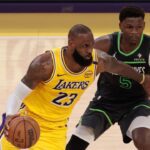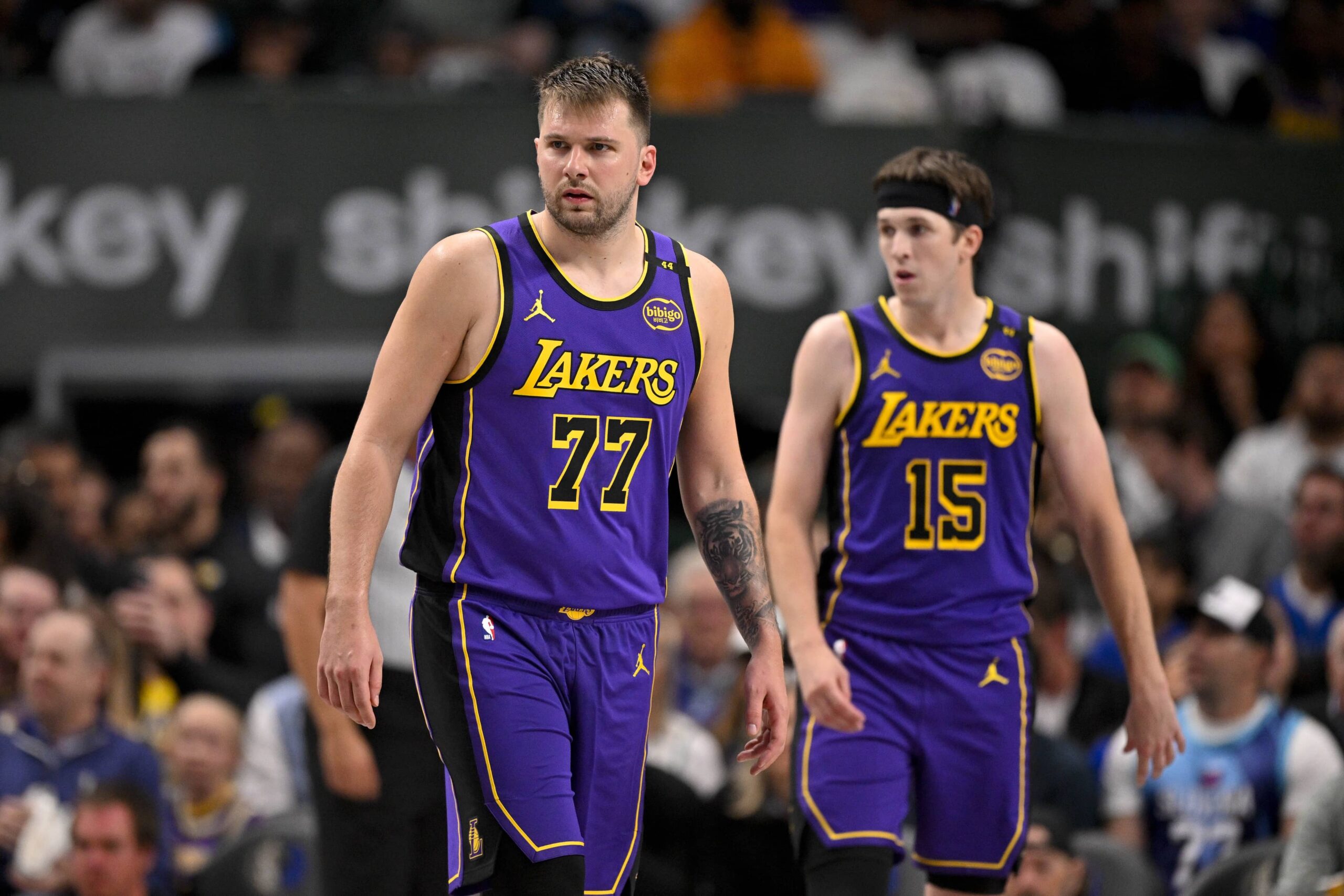
The first domino fell, and it was a big one. Austin Reaves is staying in Los Angeles with a four-year, $185 million deal and a player option in the final year. He declined his $14.9 million option and got paid like the star he’s become, after putting up 23.3 points, 4.7 rebounds, and 5.5 assists in 51 games. The Lakers didn’t flinch. They looked at what he is, decided he’s part of the core, and wrote the check.
That contract is a statement. It says this isn’t just Luka Doncic surrounded by role players. Reaves is 28; he can shoot off anything, he handles pressure, and he already knows how to share a floor with a superstar without the whole thing turning into a mess.
They also came out of the draft with something interesting. Cameron Carr fell to 24 when a lot of draft people had him going earlier, and the Knicks took him before sending the pick to LA. At Baylor, he averaged 18.9 points, 5.8 rebounds, 2.6 assists, and 1.3 blocks while shooting 49.4% from the field and 37.4% from three.
Big, athletic, doesn’t need the ball to be useful, can defend multiple positions. That’s exactly the wing profile this team has been hunting for years. If he develops, this pick looks like a steal.
So right now the roster has Luka, Reaves, Carr, Dalton Knecht, Jarred Vanderbilt, Deandre Ayton, and Marcus Smart if both opt in. That’s a functional team. It’s not a championship team.
The Lakers went 53-29, earned the four seed in the West, handled Houston in the first round, and then got swept by the Thunder in the second. Luka’s hamstring took him out of that series, which obviously changed things, as he averaged 33.5 points, 7.7 rebounds, and 8.3 assists during the regular season, so you can’t just pretend his absence was a footnote.
But even with that caveat, the sweep exposed the same structural problems that keep showing up. Not enough size. Not enough defense. Not enough shooting depth. And the LeBron James situation still needs a real answer.
Reaves is handled. Carr is in. Everything else starts now.
1. Offer Walker Kessler A Four-Year, $136 Million Contract
This is the swing worth taking. Walker Kessler is the type of center that turns Luka’s offense from godly to championship level. He doesn’t need post touches. He doesn’t need isolation sets. You hand him a screen, he rolls, he catches lobs, he finishes at the rim, and then he goes back to protecting the paint. That’s it. That’s everything Luka needs from a center.
The catch is that he’s a restricted free agent, which means the Jazz can match whatever the Lakers offer. Restricted free agency is annoying for everyone involved. The team trying to make a move, the player trying to get paid, and the fans watching it drag on for two weeks. But the situation in Utah is already messy enough that it’s worth pressing.
ESPN’s Tim MacMahon reported the Jazz offered Kessler five years, around $140 million, and he turned it down. That alone tells you something. His side wants more, and by all accounts, the relationship has gotten tense. Jake Fischer reported the Lakers had been tracking Kessler as a serious target for a while, and they’ve done genuine due diligence on him alongside Jalen Duren.
So here’s the move: offer Kessler four years, $136 million.
Year-by-year:
2026-27: $31.6M
2027-28: $33.1M
2028-29: $34.8M
2029-30: $36.5M
The Jazz offered roughly $28 million a year over five years. The Lakers come in at $34 million a year over four, and now Utah has to actively decide to match a number that’s significantly above what they already put on the table. If Kessler is already frustrated with how the process went, the offer sheet becomes about more than just money. It becomes leverage.
The injury risk is real, and it would be dishonest to skip over it. He played five games last season because of a torn labrum in his left shoulder.
In those five games, he posted 14.4 points, 10.8 rebounds, 3.0 assists, 1.8 blocks, and 1.4 steals on 70.3% shooting, which is borderline absurd, but the real sample to evaluate is the 58-game season before that: 11.1 points, 12.2 rebounds, 2.4 blocks. A real defensive anchor. A genuine rim presence. Not a star, but exactly the right kind of supporting piece for a team built around a ball-dominant creator.
The Lakers had a 116.4 defensive rating last season. That’s not a number a team with championship aspirations can live with. The Thunder, Spurs, and Rockets kept hunting the paint because there was nothing scary waiting for them there. Kessler changes that.
And the offensive fit is almost too easy to explain. Luka runs high pick-and-roll, Kessler rolls hard to the rim, Reaves attacks the weak side, and shooters stretch the floor. That’s not complicated. That’s just good basketball.
Getting there requires painful cap decisions involving LeBron’s hold, Rui Hachimura, Luke Kennard, and several other pieces. This isn’t a small tweak; it’s the big swing of the offseason. But if the Jazz fold and don’t match, the Lakers solve center for the next four years. That’s worth the effort.
2. Trade For Jarrett Allen From The Cavaliers
If Kessler doesn’t happen, shift to Plan B. And Plan B is pretty good. Brian Windhorst raised the idea of the Lakers being open to Jarrett Allen in a LeBron sign-and-trade scenario with Cleveland.
That specific framework probably only works if LeBron actively wants to go there, which is its own complicated conversation. But the relevant part is simpler: Allen’s name keeps coming up in connection with the Lakers’ center problem, and the Cavaliers are reportedly more willing to move him than Evan Mobley, whose long-term value to Cleveland is clearly higher.
Here’s the trade that could work:
Lakers receive: Jarrett Allen
Cavaliers receive: Deandre Ayton, Jarred Vanderbilt, Dalton Knecht, 2033 first-round pick
Allen is entering the first year of his three-year, $90.7 million extension at $28 million in year one, then $30.2 million and $32.5 million. Ayton at $8.1 million if he opts in, Vanderbilt at $12.4 million, and Knecht at $4.2 million gets you close enough on the salary side that the structure is realistic.
Cleveland’s reason to listen is the pick. Ayton replaces their center depth with a cheaper deal. Vanderbilt gives them a defensive wing next to Donovan Mitchell and James Harden. Knecht is a cheap shooter with upside. But a 2033 Lakers first-round pick is the real asset, far enough out that nobody knows what the team looks like, and Lakers picks have historically carried value because of the franchise’s tendency to always be relevant or always be in chaos.
For the Lakers, the case for Allen writes itself. He averaged 15.4 points, 8.5 rebounds, and 1.8 assists while shooting 63.8% from the field. He’s not a stretch center. He’s not going to run your offense or rack up highlights. He screens, he rolls, he finishes clean catches, he defends, he rebounds, and he can handle playoff minutes without the game passing him by.
Luka makes centers money. We’ve seen it in Dallas. Give him a center who can catch, roll hard, and run the floor, and the offense practically runs itself. Allen would eat lobs all season without the Lakers needing to design plays specifically for him.
The cost stings. Knecht is young and can shoot, Vanderbilt is a legitimate defender when healthy, and you’re adding a future first. But good teams consolidate. Eleven okay pieces don’t beat seven great ones arranged correctly. Allen is the right type, and trading some depth to get him is exactly the kind of decision a team built around Luka should be willing to make.
If Cleveland doesn’t want Ayton, the Lakers find a third team and adjust the packaging. The logic doesn’t change.
3. Re-Sign LeBron James To A One-Year, $52 Million Deal
This is the most emotionally charged decision of the summer, but the actual answer is pretty straightforward. If LeBron wants to come back, bring him back. One year, $52 million.
He made $52.6 million last season, so this keeps him in roughly the same salary range without committing to anything long-term. It’s respectful without being reckless. One more year alongside Luka and Reaves, in a defined role, with a clear timeline.
The reporting hasn’t been especially settled. Ramona Shelburne noted that conversations between LeBron’s camp and the Lakers had been light. He’s an unrestricted free agent for the first time since 2018, and his cap hold between $57.8 and $59.5 million is sitting on the books like a boulder. Every other move the front office wants to make this summer is partially hostage to his decision.
That’s the most urgent part of this whole thing. Not the sentimentality. Not the debate about whether he’s still good. The cap mechanics. Every day the answer doesn’t come, the Lakers lose flexibility on everything else.
On the court, he was still very good. 20.9 points, 6.1 rebounds, 7.2 assists on 51.5% shooting at 41 years old. That’s not peak LeBron, but it’s also not a guy you just let walk because you’d rather move on emotionally. He still cuts better than people give him credit for. He still mismatches opponents. He can run bench units when Luka needs rest and keep the offense from falling apart.
The mistake would be giving him multiple years, and the Lakers have to be firm about that. Two-year deals sound like a compromise. They’re actually just a different version of the problem. One year, $52 million, full no-trade clause, clear role, and then everyone moves on with clarity.
The Lakers aren’t going to replace what LeBron gives them by letting him leave. A 20-point, 7-assist forward who still makes winning plays doesn’t just appear in free agency. But they also can’t build the next chapter of this roster around his contract.
One year solves both problems. Bring him back, use him right, and then see where everything stands.
4. Re-Sign Luke Kennard As The Bench Shooter
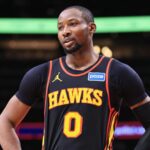
Not every roster decision needs to be complicated. Luke Kennard shoots. That’s why the Lakers got him from the Hawks at the deadline for Gabe Vincent and a second-round pick, and that’s why they should keep him.
In 32 games after the trade, he averaged 9.0 points, 2.6 rebounds, and 2.4 assists in 23 minutes while shooting 52.7% from the field and 44.8% from three. There are no hidden layers here. He does one thing at an elite level, and that one thing happens to be exactly what Luka Doncic’s offense requires from the players around him.
The offer: two years, $24 million, with a team option in year two.
2026-27: $11.5M
2027-28: $12.5M (team option)
That’s rotation shooter money without getting stupid about it. The team option matters because the Lakers are already deep into luxury tax territory with Reaves’s deal and whatever happens with LeBron. Locking up every single role player long-term isn’t a strategy, it’s a trap.
Here’s the thing teams keep forgetting: one shooter isn’t spacing. Reaves shoots well. Rui shoots well. Carr shot 37.4% from three at Baylor. But Kennard is the actual off-ball specialist; the guy defenses have to track constantly, the one who turns Luka’s hesitation dribbles into corner threes for someone on the weak side. That’s a specific skill, and it’s one the Lakers shouldn’t just assume they can replace with a cheaper option.
He’ll probably get hidden defensively in tough playoff series. That’s a real concern. But not every contract is built for 35 playoff minutes against the Thunder. Some players exist to help you win regular-season games, keep the offense clean, and give you specific matchup advantages in certain series. Kennard does all of that.
Two years with a team option. Pay the shooter.
5. Bring Back Rui Hachimura Before He Gets Lost In The Chaos
Rui Hachimura is in genuine danger of becoming an afterthought this summer, and that would be a mistake.
There’s already reporting suggesting he could be squeezed out given everything else the Lakers are juggling: Reaves’s new deal, the LeBron uncertainty, the center search, the cap holds stacking up everywhere. It’s easy to see how a front office running a complex offseason just… moves on without making his situation a priority.
But look at what he actually did. 11.5 points, 3.3 rebounds, shooting 51.4% from the field and 44.3% from three in the regular season. Then he exploted in the Playoffs: 17.5 points on 54.9% from the field and an absurd 56.9% from three.
That playoff number probably isn’t fully repeatable, but the larger point stands. Hachimura didn’t disappear when the games mattered. He got bigger. He made shots. He was one of the few Lakers who looked genuinely comfortable in tough moments.
I would offer him four years, $64 million in total.
2026-27: $14.8M
2027-28: $15.6M
2028-29: $16.4M
2029-30: $17.2M
He made $18.3 million last season, so the first-year number represents a pay cut. That conversation won’t be easy. But four years of security in a role that fits him perfectly should be the pitch he likes the most.
The fit is simple. He shoots, so he can play next to Luka without clogging the paint. He doesn’t need the ball, so playing next to LeBron doesn’t create friction. He can punish switches, hit corner threes, and score against smaller defenders when the matchup is right. He’s comfortable as a small-ball four when the situation calls for it.
He’s not going to create offense for others, he’s not going to change a game with his passing, and he has defensive limitations. Nobody’s asking him to be any of those things. What the Lakers need is adult, reliable wings who can be trusted in important moments. Carr is a rookie. Vanderbilt’s health is always a question mark. Knecht is still figuring out how to impact games consistently. If Rui leaves, the forward depth gets thin in a way that would be immediately visible.
The one caveat: if his market explodes and another team shows up with $80 million, the Lakers should probably let him walk. The number has to stay reasonable.
But at four years, $64 million? Keep him. A Luka team needs shooting forwards. Rui is a shooting forward who already knows how to play next to him.
Conclusion
The path forward isn’t that complicated when you lay it out. Reaves is done. Carr adds the upside wing they needed. Now go after Kessler with an offer sheet big enough to make the Jazz genuinely uncomfortable.
If that falls through, push for Allen and give up the depth to get him. Bring LeBron back for one year, not two, not three. Keep Kennard as the bench shooter. Keep Rui if the number stays sensible.
It’s an expensive offseason. It was always going to be. The Lakers aren’t testing the waters anymore. Luka is an MVP player, Reaves just got paid, and the clock is already running. Every move this summer needs to be about winning now, not positioning for some hypothetical future when Doncic only has two more guaranteed seasons left.