The headlines from draft night were all about the top picks, the franchise guys, the names everyone had been tracking for months. But flip through both rounds carefully, and something else stands out: this class is quietly loaded with players who can flat-out shoot the basketball.
Not role players who might develop range someday. Not centers who occasionally drift to the arc. Actual shooters whose entire NBA value starts and ends with what they can do from three. That kind of depth doesn’t always show up in a single draft class, and it definitely doesn’t always get the credit it deserves.
This ranking is built on 3PM, 3PA, 3P%, free-throw percentage, shot difficulty, 3PA rate, and realistic NBA role. Here are the ten best shooters the 2026 draft had to offer.
10. Alex Karaban, Kings
Alex Karaban is more of a safe shooter than a crazy one. He played four years at UConn, so there are a lot of samples with him. Last season, he had 13.2 points, 5.3 rebounds, and 2.4 assists. The shooting was solid: 37.4% from three, 46.4% from the field, and 85.1% from the free-throw line.
He made 1.9 threes per game on 5.2 attempts. That is not giant volume, so he can’t be too high here. But it is enough, and the free throws make the shot easier to trust.
Karaban is not going to come into the NBA and create his own threes. That is not his game. He is more useful as a forward who stands in the right spot, makes the simple pass, and hits the open shot when the defense helps.
The Cavaliers picked him at No. 29, then he ended up with the Kings. For the Kings, that is fine. They needed more size and more shooting, and Karaban gives them both without trying to do too much.
He is not a flashy shooter. But he is a shooter.
9. Tyler Bilodeau, Nets
Tyler Bilodeau has one of the nicest percentages in the whole class. He shot 46.4% from three at UCLA. That jumps out right away. He also went 87.3% at the line, scored 17.6 points per game, and grabbed 5.6 rebounds.
The reason he is not higher is simple: he didn’t take a huge number of threes. Bilodeau made 2.1 per game on 4.5 attempts. That is good for a forward, but this list has guys taking seven, eight, and almost 10 threes per game.
The Nets got him at No. 43 last night, and that is a good swing in the second round. His NBA job should be simple. Hit open threes, give some size, maybe play some pick-and-pop, and don’t make the offense slower.
He doesn’t need to be a star. He doesn’t even need to be a big scorer. If he shoots around 38.0% or 39.0% in the NBA, he can be useful.
Bilodeau is the type of player who can have a quiet game, then you check the box score and he hit three threes. That is good value at No. 43.
8. Cameron Carr, Lakers
Cameron Carr is here because he brings shooting with a strong wing body and the potential to become the ultimate draft night steal.
At Baylor, he had 18.9 points, 5.8 rebounds, 2.6 assists, and 1.3 blocks. The 3-point number was 37.4%, with 2.3 makes on 6.1 attempts per game. He also shot 49.4% from the field and 80.1% from the line.
That is a good mix.
Carr is not a pure shooter; he does other things on the floor. He can get out in transition, attack the rim, defend a little, and use his size. But the three is still a big part of why he was a first-round pick.
The Knicks drafted him at No. 24 before the trade sent him to the Lakers. That landing spot makes sense. The Lakers always need wings who can shoot and not get killed on defense to help Luka Doncic and Austin Reaves.
The percentage is not elite, but 6.1 attempts per game is enough volume. Carr was not scared to take them. And because he has size, he doesn’t need to be perfect as a shooter to stay on the floor.
He is more of an all-around wing than a specialist, but the three is legit enough for this list.
7. Isaiah Evans, Timberwolves
Isaiah Evans is a volume guy. He didn’t shoot some crazy percentage at Duke. It was 36.1% from three. But he took 7.4 threes per game and made 2.7. That is why he is here.
There is a big difference between shooting 36.0% on three attempts and shooting 36.0% on more than seven attempts. Evans was taking a lot of them. He was clearly being used as a shooter.
His season was 15.0 points, 3.2 rebounds, 1.3 assists, and 86.0% from the line. That free-throw number helps a lot. It makes the three-point percentage look better than just “36.1%” on paper.
The Nets picked him at No. 33, then he moved to the Timberwolves. That could help him a lot because he won’t need to do too much. With Anthony Edwards and now LaMelo Ball after a blockbuster trade, Evans can just run to the open spot and shoot.
That is probably the best version of him early. He is not the most prolific shooter on the list. But 2.7 made threes per game from a 6-foot-6 wing is too much to leave out.
6. Keaton Wagler, Clippers
Keaton Wagler is not really a “stand in the corner and shoot” guy. The Clippers took him No. 5 because he can do more than that. At Illinois, he had 17.9 points, 5.1 rebounds, and 4.2 assists. He shot 39.7% from three, 44.5% from the field, and made 2.4 threes per game.
That is a very good shooting season for a guard who also had to pass and create like a No. 1 offensive option.
Wagler is not as wild from three as some of the names ahead of him. He didn’t take nine threes per game. He took 5.9. But the percentage was elite, and the jumper fits with the rest of his game.
That is the important part. He can shoot when he is open, but he can also take one dribble and pull up. He can play off a screen. He can punish a defender for going under.
The Clippers probably won’t use him as only a shooter. They need him to handle, pass, and score. Still, the three is the skill that should translate first.
He is not No. 1 because the volume is not high enough. But he is one of the better shooting guards in this class.
5. Emanuel Sharp, Kings
Emanuel Sharp is here to shoot; that’s simple. The Kings took him at No. 45, and that pick makes sense because Sharp had one of the biggest shooting samples in the draft. At Houston, he made 2.6 threes per game on 7.1 attempts. He shot 37.2% from deep and 89.1% from the line.
Sharp also scored 15.5 points per game with 3.0 rebounds, 1.7 assists, and 1.2 steals. He shot only 41.3% from the field, but that is not a big shock. His whole offense was based on jumpers, and a lot of them were tough.
He is not a big guard. He is not a lockdown defender. So yes, the shooting has to be good enough for him to play.
But that is why he belongs here. His NBA case is obvious. Come off the bench, take threes, maybe get hot, change a few minutes. The Kings got a real gunner in the second round.
4. Ryan Conwell, Heat
Ryan Conwell is probably the weirdest one on the list. The percentage was not great. He shot 34.5% from three at Louisville. Usually, that doesn’t scream top-four shooter.
But then you see the volume. Conwell took 9.6 threes per game. That is crazy. He made 3.3 per game, scored 18.8 points, added 4.8 rebounds and 2.7 assists, and shot 83.2% from the line.
So yeah, the percentage is not pretty. But he was taking every type of three. Deep ones. Contested ones. Late-clock ones. The defense knew he wanted to shoot, and he still got almost 10 attempts up every night.
That has value. The Thunder picked him at No. 37 before he ended up with the Heat. That feels like a very Heat type of pick with Giannis Antetokounmpo now in the mix, as Miami will now likely try to surround him with shooters. Older player, strong role, no confusion about what he does.
Conwell is not as good as the top markers. If the percentage stays at 34.0%, he might struggle. But if he gets easier NBA shots and jumps closer to 37.0% or 38.0%, he becomes very useful.
3. Darius Acuff Jr., Kings
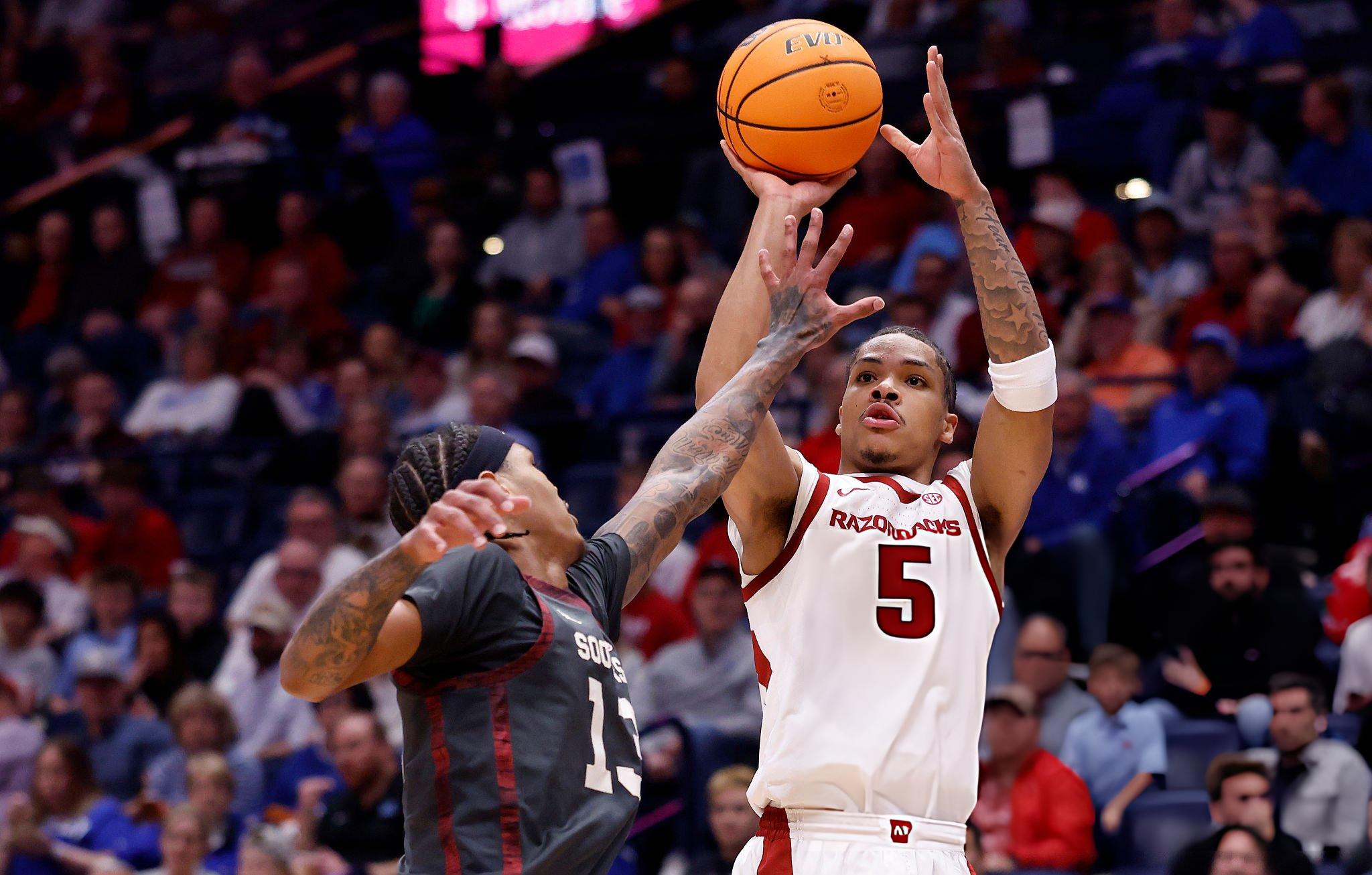
Darius Acuff Jr. is not a pure specialist, but his shooting is too good to ignore. The Kings drafted him No. 7 after he scored 23.5 points per game at Arkansas. He also had 6.4 assists and 3.1 rebounds, so he was not just a scorer. But the wild number is this: 44.0% from three.
For a freshman guard with the ball that much, that is serious. Acuff made 2.5 threes per game on 5.8 attempts. That is not the biggest volume on this list, but his threes were harder. He was taking pull-ups, threes off screens, transition threes, and shots where the defense was already focused on him.
That is different from a player catching open looks.
He also shot 48.4% from the field and 80.9% at the line. So the scoring was not only hot shooting. He was efficient everywhere.
The reason he is not No. 1 is that this list is more about 3-point specialists, and Acuff does a lot of his work inside the arc, too. But as a shooter who creates his own shot, he might be the best in the draft.
The Kings didn’t just get a shooter. They got a guard who can make defenses suffer with his own creation.
2. Christian Anderson, Hornets
Christian Anderson almost got the top spot. His numbers are exactly what you want from a guard shooter. He made 3.3 threes per game, took 7.9, and hit 41.5%. That is elite. Not “good for college.” Just elite.
He also had 18.5 points, 7.4 assists, 3.6 rebounds, and 1.5 steals at Texas Tech. So he was doing a lot more than waiting for open shots.
The Hornets took him at No. 18, and after the LaMelo Ball trade, he suddenly feels like a much bigger piece. He doesn’t have to replace Ball because that is not fair. But he can give the Hornets shooting and more point guard structure next to Brandon Miller and Kon Knueppel.
Anderson’s shooting is easy to trust because the volume and percentage both hit. A lot of guys have one or the other. He had both. He shot 47.2% from the field and 80.5% from the line, so the scoring efficiency was strong across the board.
1. Tyler Nickel, Knicks
Tyler Nickel is No. 1 because this is a shooter ranking, and he excelled in college. He is not the best player here. Darius Acuff Jr. is better. Keaton Wagler is a better prospect. Christian Anderson has more on-ball value. But Nickel is the best pure shooter.
At Vanderbilt, he made 3.1 threes per game on 7.6 attempts. He hit 40.0% from three, 84.7% from the line, and scored 13.5 points per game. He also added 3.3 rebounds and shot 44.5% from the field.
The big thing is how much he lived from three. Three out of every four shots he took came from behind the arc. That tells you everything.
The Suns picked him No. 47, then he ended up with the Knicks. For the Knicks, the job is not complicated. Move without the ball. Stand in the right spot. Shoot when Jalen Brunson or another creator draws help.
Nickel has good size at 6-foot-7, so he can get shots off as a wing. He doesn’t need to be a big creator. He just needs to make defenses pay.
And that is why he is the top shooter here. High volume, strong percentage, good free throws, and a role that is all about threes.