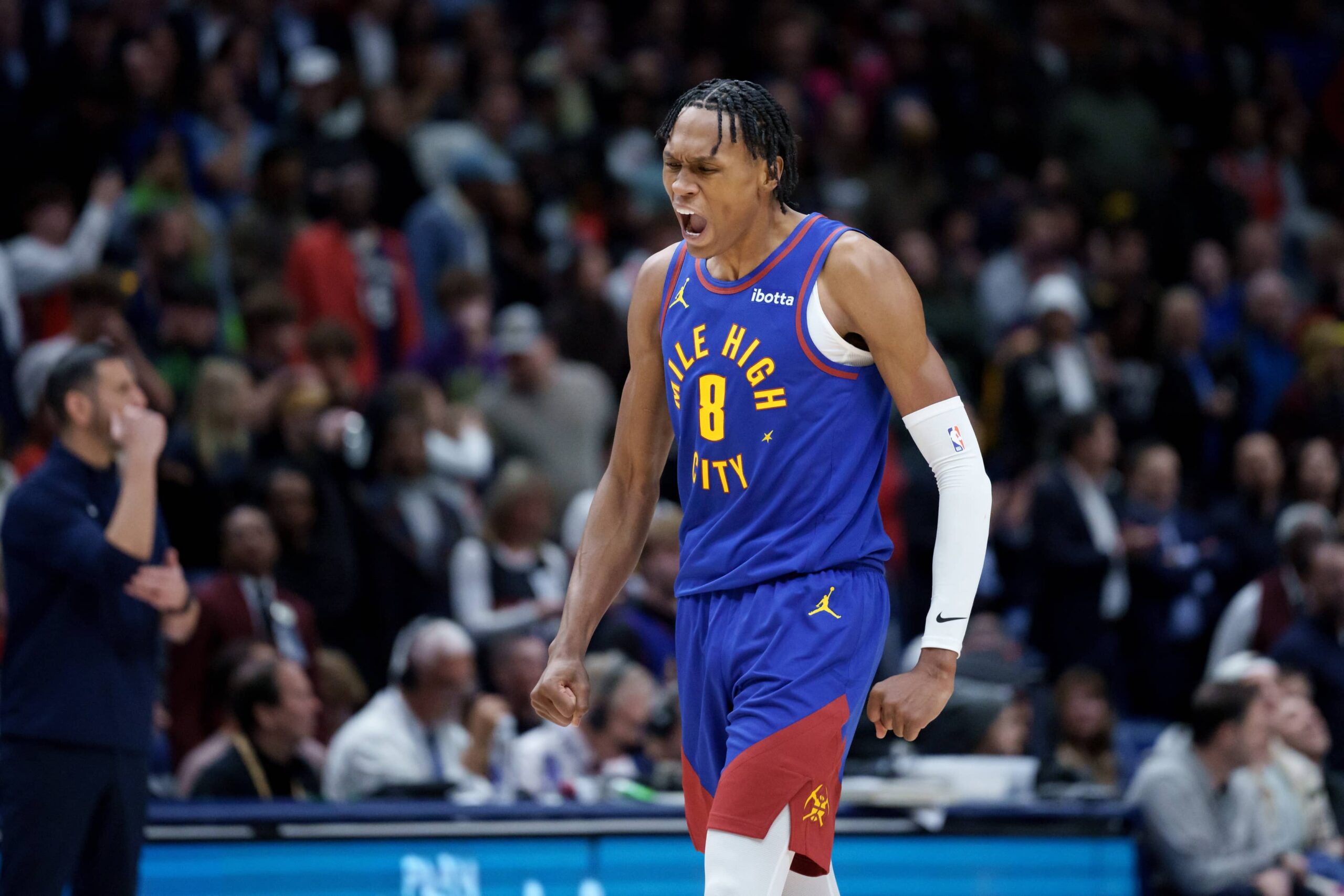
Peyton Watson’s restricted free agency is starting to feel less like a long negotiation and more like the Nuggets potentially parting ways with their young player.
The Nuggets want to keep him, as Sam Amick reported that Denver plans to match any offer sheet for Watson, but the team is also open to sign-and-trade scenarios if the two sides can’t close the gap on a new contract. That is the whole tension here: the Nuggets don’t want to lose a 23-year-old wing for nothing, but they also can’t give him close to $30.0 million per season like it’s nothing.
Watson gave Denver a real breakout season before his hamstring issues changed the end of his year. He averaged 14.6 points, 4.9 rebounds, 2.1 assists, 0.9 steals, and 1.1 blocks in 29.6 minutes, while shooting 49.1% from the field, 41.1% from three, and 73.0% from the line. Watson produced starting-level wing numbers, and it is exactly why his camp can push for serious money.
The problem is Denver’s cap sheet. Sports Illustrated reported that the Nuggets’ expected offer could land somewhere north of $28.0 million to $30.0 million per year, but the most likely range sits around $25.0 million per year if the $30.0 million number is more leverage than anything else.
Either way, that is heavy. Denver already has Nikola Jokic, Jamal Murray, Aaron Gordon, Cameron Johnson, and Christian Braun taking major money, and keeping Watson without dumping another salary would push the Nuggets deep into second-apron territory.
That is why a sign-and-trade suddenly started to make noise. Denver can’t move Watson like a salary dump, because he is too young, too athletic, and too productive. But if another team wants to force the issue with a massive offer sheet, the Nuggets have to ask for real value back: useful rotation salary, young talent, and first-round picks.
4. Bulls Land The Athletic Wing They Already Liked
Chicago Bulls Receive: Peyton Watson
Denver Nuggets Receive: Patrick Williams, 2029 first-round pick, 2031 first-round pick
The Bulls are here because they were already linked to Watson before free agency. Jake Fischer reported that the Lakers, Bulls, and Nets were potential suitors, and the Bulls also had trade interest before the deadline. That makes this a fair framework, even if the Bulls have changed a lot since then.
The Bulls went 31-51 and finished 12th in the East, so they aren’t one move away from anything. But since Watson is 23, he fits the type of roster Chicago should want around Matas Buzelis, Josh Giddey, Nic Claxton, and younger athletes. He gives them a 6-foot-8 defender who can run, block shots, cut, and score without needing 20 shots.
Patrick Williams is the salary piece, not the prize. Williams averaged 7.0 points, 3.0 rebounds, and 1.5 assists last season while shooting only 37.2% from the field. He is 24 and still has the body type teams like, but he hasn’t become the two-way forward the Bulls expected when they drafted him No. 4. His contract is also huge on a five-year, $90.0 million deal with an $18.0 million salary. That is why two first-round picks have to be in this.
For the Nuggets, Williams would be a buy-low forward behind Gordon and Johnson. He can guard wings, play some small-ball 4, and maybe shoot better in a Jokic offense with better spacing and easier decisions. But Denver can’t pretend he is close to Watson’s value right now. Watson is better, younger in terms of development curve, and coming off a better season.
That is why the picks carry the trade. The 2029 first-round pick gives Denver a future trade chip during the Jokic window. The 2031 first-round pick gives them another asset when Murray, Gordon, and the rest of the core get older. If the Bulls want Watson instead of just throwing an offer sheet and hoping Denver blinks, this is the price. Williams alone doesn’t start the call.
3. The Hawks Turn Two Rotation Players Into A Higher-Ceiling Wing
Atlanta Hawks Receive: Peyton Watson
Denver Nuggets Receive: Nickeil Alexander-Walker, Corey Kispert, 2029 first-round pick
The Hawks are actually a great fit for a player like Watson since they declined Jonathan Kuminga’s option. Nickeil Alexander-Walker makes $14.4 million in 2026-27, and Corey Kispert makes $14.0 million. That is $28.4 million outgoing for the Hawks, which lines up with a Peyton Watson contract starting around $28.0 million.
The Hawks have a strong basketball reason to chase Watson. They went 46-36, finished sixth in the East, and lost to the Knicks in the first round. They already changed the roster a lot after the Trae Young trade, and their current build is more about size, defense, and athletic wings around Jalen Johnson, Dyson Daniels, and Onyeka Okongwu. Watson fits that identity better than Kispert and gives them more defensive ceiling than Alexander-Walker.
This would be expensive for the Hawks, no doubt. Alexander-Walker just won Most Improved Player after averaging 20.8 points, 3.4 rebounds, 3.7 assists, and 1.3 steals, while shooting 45.9% from the field, 39.9% from three, and 90.2% from the line. He was not a throw-in. He became one of the best stories of the season. Kispert is also useful as a spacer after averaging 9.2 points, 2.3 rebounds, and 1.6 assists on 46.7% from the field and 36.7% from three.
For Denver, this is a great non-star return. Alexander-Walker gives the Nuggets a real guard-wing scorer who can play next to Nikola Jokic, Jamal Murray, and Christian Braun. Kispert gives them another shooter who can live off Jokic passes, run weak-side actions, and make defenses pay for helping too much. The Nuggets lose Watson’s size and upside, but they replace one expensive player with two playable rotation guys at almost the same combined salary.
2. The Nets Use Their Pick Stash To Add Another Young Forward
Brooklyn Nets Receive: Peyton Watson
Denver Nuggets Receive: Terance Mann, Noah Clowney, 2028 first-round pick, 2030 first-round pick
The Nets are one of the most aggressive teams in this whole situation because they actually have the cap space and picks to make Denver uncomfortable. Amick reported that the Nets are one of only two teams with the cap space to give Watson the offer sheet he wants. The Nets still have around $25.0 million in cap space and 13 future first-round picks after landing Julius Randle, so the option is there.
The Nets went 20-62 and finished 13th in the East, so they aren’t giving up two first-round picks because Watson makes them a contender tomorrow. They would be doing it because Watson fits the age timeline better than some of their current veterans. Michael Porter Jr. is making $40.8 million, Julius Randle is also in the frontcourt after the Nic Claxton trade, and the Nets still need defense around those scoring forwards. Watson gives them a younger, faster, better defensive wing next to Porter, Randle, Keon Ellis, and Day’Ron Sharpe.
Terance Mann is the salary piece at $15.5 million, which works much better for Denver than taking on a huge number. He is 30, not a core piece, but he can defend guards, move the ball, cut, and play low-usage minutes next to Jokic. Noah Clowney is the younger piece with his $5.4 million deal, and his age makes him more interesting for Denver than another random veteran.
Still, Mann and Clowney don’t equal Watson at all. That is why the Nets have to add two first-round picks to make it interesting. The 2028 first-round pick gives the Nuggets a more immediate asset, and the 2030 first-round pick gives them another trade piece for later. Denver doesn’t have a huge pick stash, so getting two first-round picks back for a player it might lose or overpay is a strong pivot.
For the Nets, it is aggressive but logical. They can use cap room, they can spare picks, and they need a young two-way forward. For the Nuggets, this is the best asset package if they prefer picks over a better player.
1. The Clippers Build A Fire Swap Around Bennedict Mathurin
Los Angeles Clippers Receive: Peyton Watson
Denver Nuggets Receive: Bennedict Mathurin, 2029 first-round pick
This is the best return because Bennedict Mathurin is actually good. If the Nuggets are losing Watson, they shouldn’t settle for a weak role player and picks only. Mathurin gives them a good rotation scorer who is also 24, so Denver isn’t only saving money. It is changing the type of young player next to Jokic and Murray.
The Clippers are the strongest reported team here. Amick reported that they have shown legitimate interest in Watson, and that they are one of the only teams with the cap space to submit the offer sheet he wants. The Clippers are dealing with their own restricted free agency situation with Mathurin, which is exactly why a dual sign-and-trade makes sense as a framework.
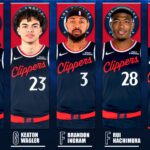
The Clippers went 42-40, finished ninth in the West, and are moving into a different build after major changes. They traded Kawhi Leonard to the Raptors, with Brandon Ingram, Gradey Dick, two first-round picks, a pick swap, and two second-round picks coming back, and have recently signed Rui Hachimura from the Lakers. That makes Watson a very logical target to balance their scoring with defense. He is younger than Kawhi, more defensive than Mathurin, and fits a forward group with Ingram and Gradey Dick much better.
Mathurin is the real deal for Denver. He ended at 17.6 points, 5.4 rebounds, and 2.4 assists last season. He also had a 38-point game against the Nuggets after joining the Clippers, so Denver knows exactly how dangerous his scoring can get. Mathurin is not the same defender as Watson, but he gives the Nuggets downhill scoring, free-throw pressure, and bench offense. That is valuable because the Nuggets can get too Jokic-dependent when Murray is off the floor.
The money could also line up if both players land in the same contract range. Mathurin is a restricted free agent too, and if he wants a big role and the Clippers prefer Watson’s defense, the sign-and-trade path gives both teams a way out, with the Nuggets likely receiving Mathurin at $17-$20 million per year.
The 2029 first-round pick pushes it over the top for Denver. The Clippers acquired an unprotected 2029 first-round pick from the Pacers in the Mathurin trade, and that is the type of asset Denver should demand. If the Nuggets are swapping Watson’s defense for Mathurin’s scoring, they still need one premium pick.
This is the best deal. The Clippers get the better defensive fit while the Nuggets get a young scorer and a first-round pick.