The Wizards finally have something that looks interesting again. After going 17-65 in 2025-26, they selected AJ Dybantsa with the No. 1 pick in the 2026 NBA Draft. That was the right move.
But Dybantsa is not joining a rebuilding team with no veterans and no playmaking. Trae Young just agreed to a four-year, $212.0 million extension, so the Wizards have their lead guard locked in. Anthony Davis is also there, even if he never actually debuted for them yet.
That gives Washington a weird but serious group. Young can run the offense. Dybantsa gives them a future No. 1 scorer. Davis can still be elite defensively if healthy. Alex Sarr is coming off a strong second season, even with injury issues.
The Wizards are not suddenly a contender. That would be too much. But they are also not the same dead 17-win team anymore. If Young and Davis are healthy, and if Dybantsa is as real as expected, Washington could become one of the most interesting teams in the East.
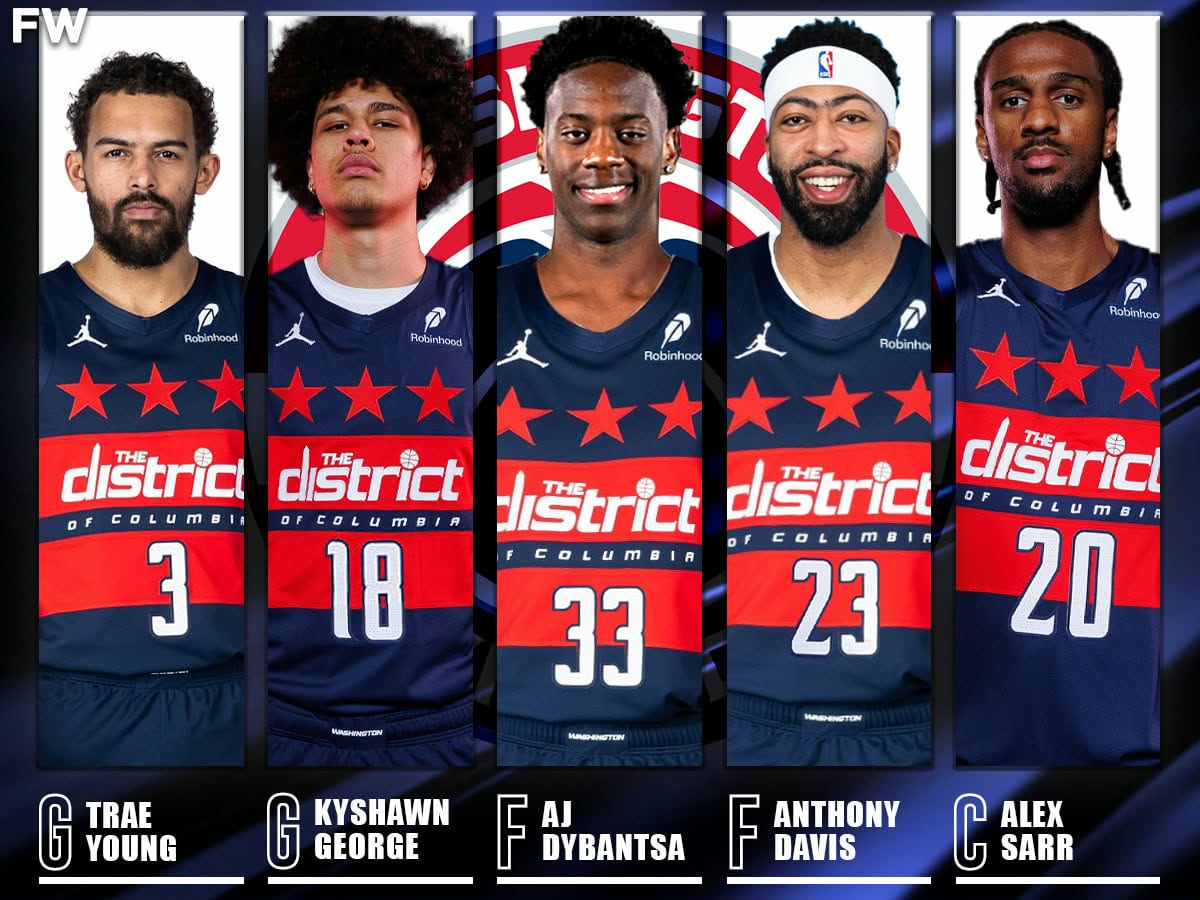
Projected Starting Lineup
PG: Trae Young
SG: Kyshawn George
SF: AJ Dybantsa
PF: Anthony Davis
C: Alex Sarr
This lineup should change the Wizards’ profile fast if everyone is healthy.
Last season, Washington was one of the worst advanced-stat teams in the NBA. The Wizards had a 111.0 offensive rating, which ranked 28th, and a 122.7 defensive rating, which ranked 30th. Their net rating was minus-11.8, also 30th. They played fast too, with a 101.4 pace that ranked sixth, but that speed didn’t create efficient offense or stable defense. It was mostly empty pace.
This group has more structure. Young gives them real half-court shot creation after Washington ranked 25th in points per game at 112.9. Dybantsa gives them a downhill wing scorer, and Sarr gives them a center who had 16.3 points, 7.4 rebounds, and 2.0 blocks last season. George adds size and 38.4% three-point shooting. Davis is the swing piece because his healthy version can still change the defense.
The defensive jump could be bigger than the offensive jump. Davis and Sarr together give the Wizards two rim protectors. George and Dybantsa give them size on the wing. Young will still be attacked, but this is a much better shell behind him.
A top-10 defense is too aggressive for now. Moving from 30th to league average would already be a huge step.
Trae Young Can Go Back To His Best Version
Trae Young barely got to show anything with the Wizards after the trade. He played only five games for Washington because of back, quad, and knee issues, and his whole 2025-26 season was limited to 15 games. In those games, he finished with 17.9 points, 2.0 rebounds, and 8.0 assists while shooting 45.8% from the field and 33.8% from three.
That is not a normal Young season. His career numbers are still 25.1 points and 9.8 assists, so the Wizards are betting more on the long résumé than the small sample from last year.
The $212.0 million extension is risky because of the injuries and defense. ESPN’s Brian Windhorst already criticized the contract hard. But basketball-wise, Young makes sense for Dybantsa. He can create easy shots, force traps, throw lobs, and help the rookie get cleaner looks before he is ready to carry every possession.
Washington needed an offensive organizer. Young is that. The whole thing now depends on his body and his willingness to make Dybantsa’s life easier.
A Key Role For Kyshawn George’s Development
Kyshawn George should be the projected shooting guard because this lineup already has enough shot creation with Trae Young and AJ Dybantsa. What it needs next to them is size, defense, and a player who can hit open threes without forcing the game.
George had a strong second season with 10.7 points, 4.1 rebounds, and 3.0 assists while shooting 44.8% from the field and 38.4% from three. That is a good role-player jump after a rookie year where he looked more raw. The passing also matters because the Wizards can use him as a quick connector instead of only a spot-up wing.
The defensive fit is the main reason to start him. Young is small and will get attacked. Dybantsa is a rookie. Davis and Sarr can protect the paint, but they still need size at the point of attack. George gives Washington a 6-foot-8 wing who can take tougher matchups and keep the lineup bigger.
AJ Dybantsa Will Have A Great Team To Compete
AJ Dybantsa is the reason this lineup finally has a real ceiling. He posted 25.5 points, 6.8 rebounds, and 3.7 assists at BYU while shooting 51.0% from the field. He also lived at the line and finished 72.3% of his shots at the rim.
That is why the Wizards took him No. 1. He is not just a wing with size. He already has real scoring tools. The three-point shot is the main question after he hit 33.1% from deep. The defense also needs more discipline. But his body, burst, midrange game, and downhill pressure are already NBA-level traits.
The fit with Young is strong. Dybantsa won’t need to bring the ball up and solve every possession right away. Young can feed him in transition, get him touches after switches, and use him as a cutter when defenses overhelp.
The fit with Davis and Sarr is also interesting. Dybantsa can defend wings, rebound, and run. If the jumper improves, Washington can build a real oversized lineup around him. The Wizards needed a face of the future. Dybantsa is that player now.
A Frontcourt Pairing That Will Terrorize Offenses
Anthony Davis is the projected starting power forward, but this is the most unstable part of the lineup. Davis didn’t debut for the Wizards after the trade because of a lingering finger injury.
Across 20 games before that, he had 20.4 points, 11.1 rebounds, 2.8 assists, 1.7 blocks, and 1.1 steals while shooting 50.6% from the field. Those numbers still show he can dominate when healthy.
The problem is obvious. Davis is 33, expensive, and has a long injury history. If the Wizards start badly, it would not be shocking if his name comes up again in trade talks.
For now, though, Davis should start if he is healthy. Power forward is also the better role for him. He has always looked more comfortable when he can play next to another big man, protect the rim from the weak side, and not absorb every center matchup all night.
Next to Sarr, Davis can float more defensively. On offense, he can screen for Young, attack mismatches, and take pressure off Dybantsa. The fit is strange, but the talent is still there.
Alex Sarr should still start at center if he is ready for opening night. Sarr had surgery in June to repair a fractured right foot suffered during an offseason workout.
The Wizards expect him to recover before next season, but the injury is still important because his second year already had a lot of health issues. He played only 48 games.
The good part is the production. Sarr finished with 16.3 points, 7.4 rebounds, 2.7 assists, and 2.0 blocks while shooting 48.2% from the field. He also made 1.0 threes per game, which matters in this lineup. He is not a sniper, but defenses have to respect him a little more than they did as a rookie.
His growth was real. Sarr looked stronger, more aggressive, and more comfortable as a scorer. The shot-blocking is already one of his biggest weapons, and playing next to Davis should help him a lot. Davis can call coverages, handle stronger matchups, and cover mistakes.
A Sarr-Davis frontcourt is huge. The spacing can get tight, but the defense could be serious if both are healthy. For a team that was terrible last season, that is a good place to start.
Second Unit Pieces
The bench is actually one of the more fun parts of this roster. Tre Johnson can move into a more natural scoring role off the bench after a great rookie year.
He had 12.2 points per game and shot 35.8% from three in 60 games. He was forced into some tough shots last season because the roster had no order. Now he can be a 6th man, play against second units, and get easier looks next to either Trae Young or AJ Dybantsa. That should help his efficiency right away.
Bilal Coulibaly also becomes a huge piece off the bench. He had 11.7 points, 4.3 rebounds, 2.6 assists, 1.3 steals, and 1.0 blocks last season. The offense still has ups and downs, but his defense, length, and transition game fit with almost any lineup. He can play next to Johnson, Dybantsa, or Kyshawn George without needing touches.
Will Riley is another young scorer worth watching. He had 10.3 points, 2.9 rebounds, and 2.0 assists as a rookie. He is still thin, but at 6-foot-9, he gives the Wizards another forward who can shoot, run, and score in short bursts.
Bub Carrington gives them a real backup guard after posting 10.7 points, 3.4 rebounds, and 4.6 assists. Jaden Hardy adds another scorer after putting up 9.2 points in 57 games. Julian Reese gives them energy inside after averaging 11.8 points and 10.5 rebounds in 13 games. Even other less protagonists like Cam Whitmore, D’Angelo Russell, Tristan Vukcevic, and Justin Champagnie can have some playing time for stretches.
The Wizards still have questions, but at least now the bench has real young talent. Johnson, Coulibaly, Riley, Carrington, Hardy, and Reese all have a path to minutes. That is a big change from just throwing random lineups together.